A warm day in Seoul, south of the Han River, took me through several parks and stream valleys. Afterwards, the Lotus Lantern Festival was an enjoyable evening diversion.
Stage 7: Iljasan Mountain
Starting from Godeok Station, a quick walk brought me back to entrance to Myeongil Neighborhood Park and the start of Stage 7. The trail wasted no time climbing into the well-shaded forest, along a ridge. On the ridge, a nice breeze blew, helping take a little edge off the heat, which was definitely warmer than the last two days. After a short while, a pedestrian bridge took the trail across a road, keeping the trail in the park. Several access trails connected to various places in the surrounding neighborhood.
As expected, I wasn’t alone; there were plenty of other people on the trail, sitting at the benches, or using the exercise equipment scattered throughout the forest. I noticed some people were barefoot — easy because the trail tread was clean of rocks, roots, or other obstructions. The CCTV cameras continued to be regularly placed; one of them with a somewhat muffled speaker was practically shouting (in Korean) that it was a CCTV camera.
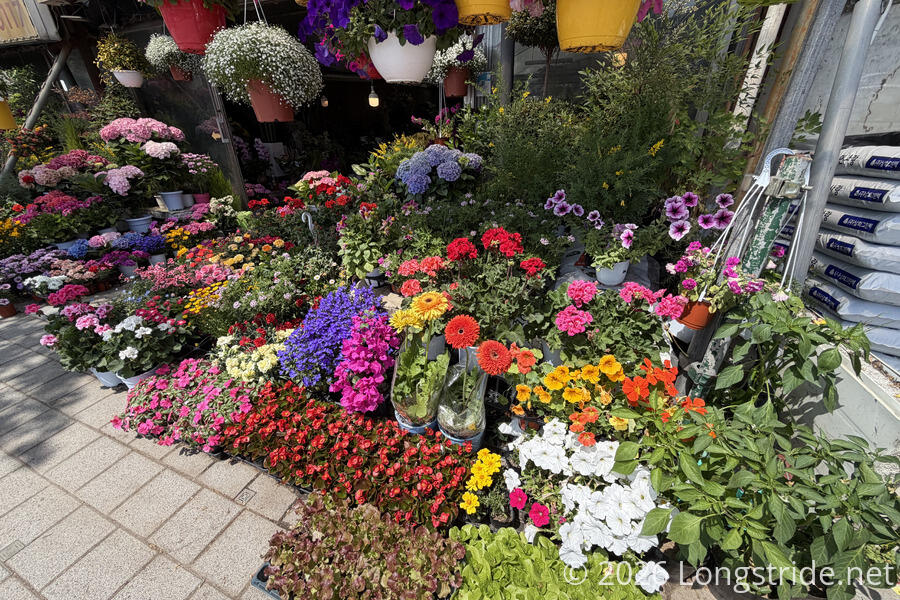
Exiting Myeongil Park on its southeast corner, the trail briefly returned to city streets, passing a long row of flower shops with colorful displays.
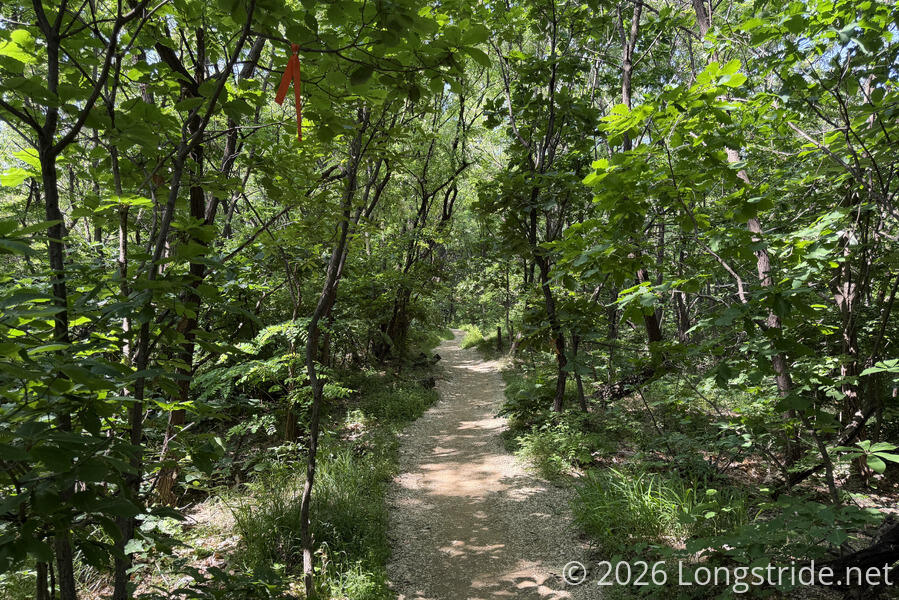
A brief jaunt down a gravel road reached the easternmost point of the Seoul Trail, and the trail turned west, beginning its climb into the forest on Iljasan Mountain. As in Myeongil Park, this was a nice, shaded stretch of trail, with plenty of benches and exercise stations, many in use. A little bit into the park, near the top of the first hill, a tacky giant banner advertised a local fish restaurant.
Despite the temperature, I noticed that nearly everyone else is wearing long pants, and usually long-sleeve shirts as well. A few people (more than I’d have expected) were fully-covered, head-to-toe, including sports balaclavas, gloves, and sunglasses, leaving nothing exposed. (I’ve done that before when skiing, or when it’s brutally cold outside, but this is clearly a large cultural difference here in Korea that deems this kind of outfit reasonable to wear in the summer.)
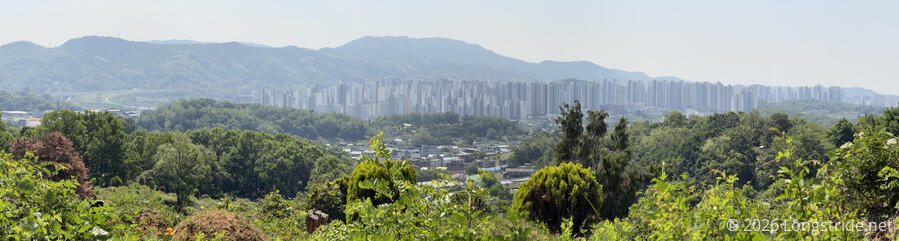
The trail on Iljasan was pretty much the only place today where I got a good view of Seoul’s skyline, and even that was mostly facing south, out of the city proper. The visible towers seemed to be in repeating cookie-cutter patterns, with a large number of very similar or identical looking buildings.
Exiting the park surrounding Iljasan, the trail followed a busy road for a short while. One of the nice things about some of the larger intersections here is large sun umbrellas to provide shade. Not every corner with a crosswalk has them, but where they’re present, it’s very nice.
Stage 8: Jangjicheon and Tancheon Streams
After another kilometer down the road (passing more flower shops), the trail turned down a narrow alleyway towards the Bangi-dong Ecological Conservation Area, which I initially missed because a truck was trying to exit from it. The conservation area is made of wetlands nestled in the space between two rivers, originally alluvial land developed for rice farming. The section started with another stamp box in front of the area’s learning center, a brown boxy building planted in the middle of a swamp. A sign suggests this is a fairly rare ecosystem inside the city.
The road eventually led to a clearing with a restroom. Rising above the trees, bland white high-rises bore the faded (or painted-over) logo of the 1988 Summer Olympics.
An exit led to a cycle and walking path along Seongnaecheon Stream.
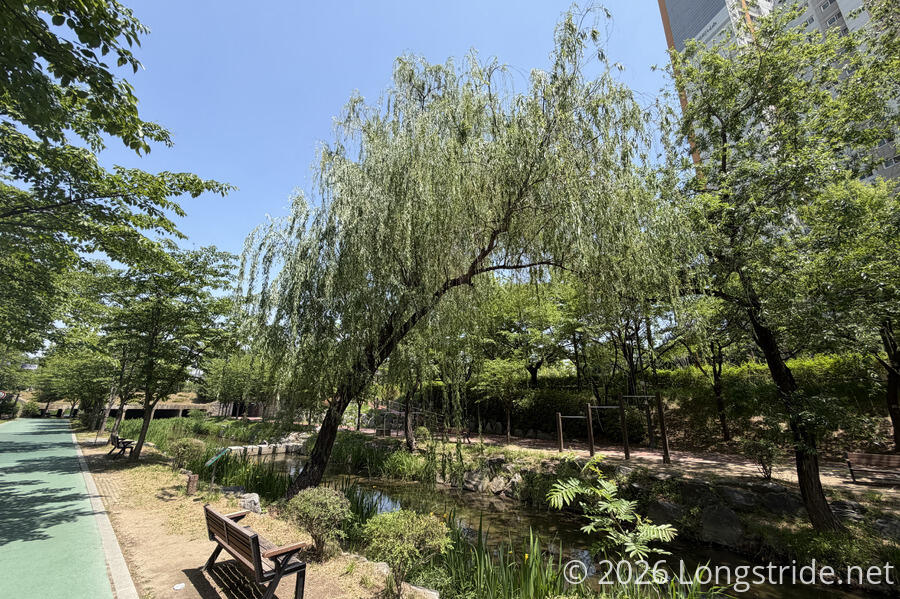
Crossing a bridge over Seongnaecheon Stream, I began following it upstream, to the south. Somewhat similar to Mukdongcheon Stream yesterday, the stream is flanked by a pair of cycling and walking path, with rows of trees isolating the park area from the rest of the city. Benches (and the occasional exercise station) offered plenty of places to sit and relax, and occasional block stepping stones provided a way to cross the creek, which only rarely had bridges across.
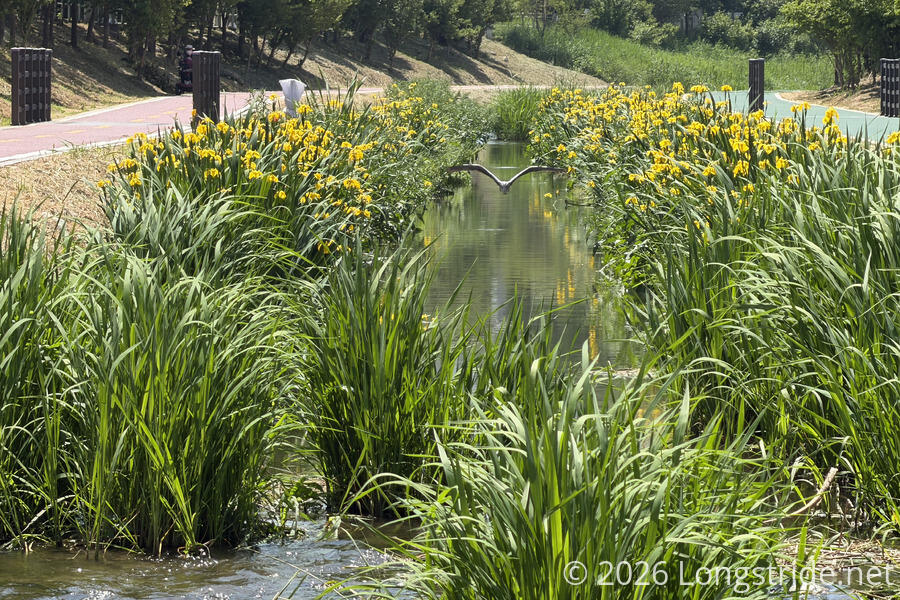
Along the stream’s course, several road bridges offered additional shade when the trees weren’t sufficient. Underneath the bridges were public art galleries sponsored by the Songpa District. Towards the end of the stretch of creek the trail followed, a row of market stalls attracted park goers.
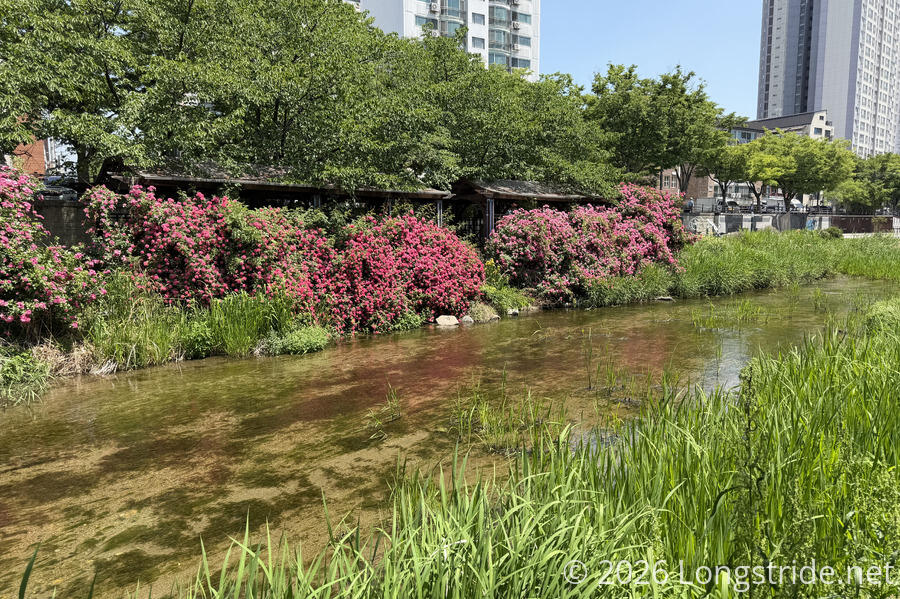
Eventually, the trail left Seongnaecheon Stream, following a sidewalk under the shade of an elevated highway, crossing a few streets and re-entering forested parkland.
By now, a nearly 1 pm, it seemed like there were fewer people out than this morning. It’s unclear to me if this was because it was now early afternoon, or because I was in a different location.
After wandering around for a while, the trail joined a walking and cycle path along the Jangjicheon River. Unsurprisingly, this was a lot like previous stream valleys: walking or cycle paths on both sides, benches, exercise stations, and the occasional bridge or stepping stone path across the river.
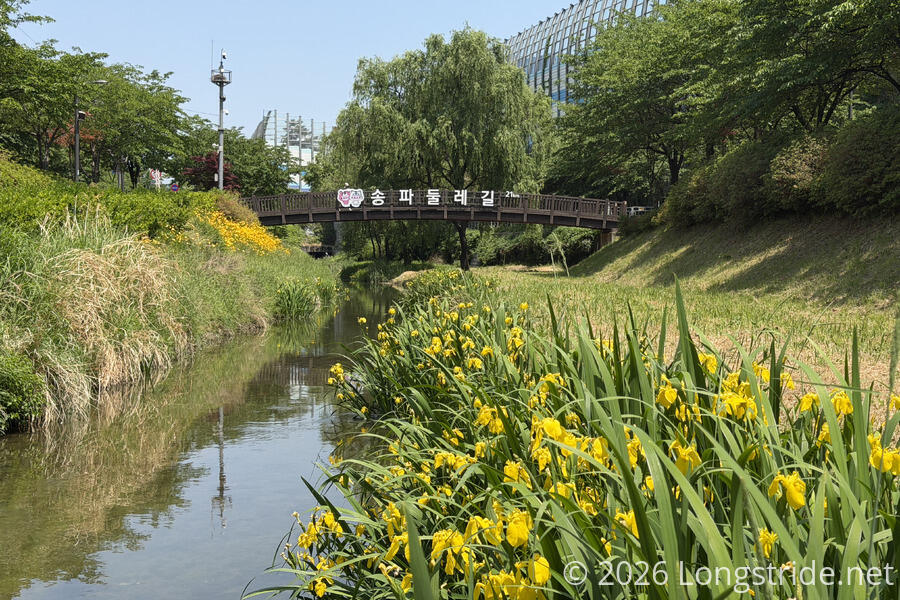
The path along the Jangicheon eventually led to an intersection with a path along the much larger Tancheon Stream. Both had numerous herons and other water birds.
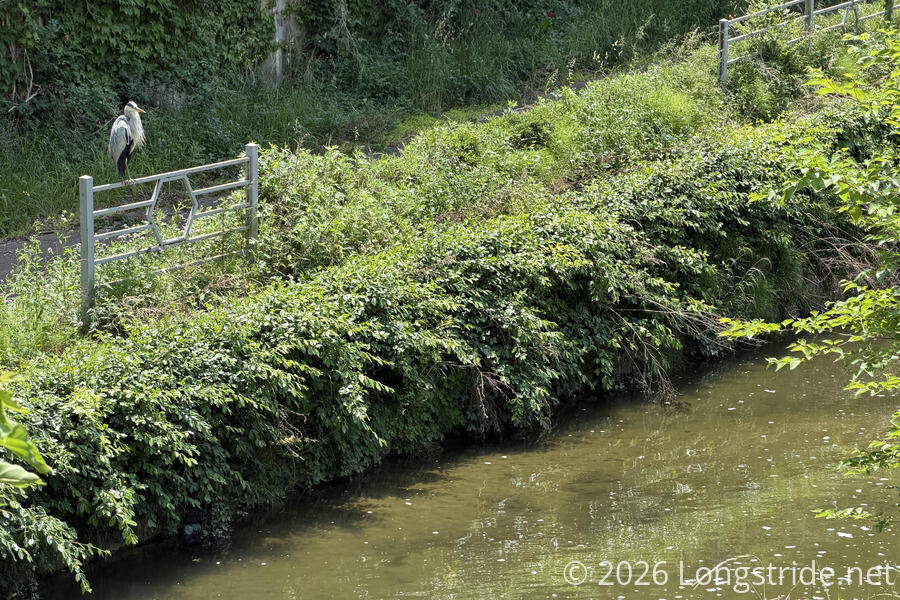
Along Tancheon Stream, the cyclepath was heavily used by cyclists, though there were a few other people out walking. Under some of the road bridges, the retaining wall was built as a large staircase meant for seating, and one of the bridges had a food truck in a larger flat area near the river. I suspect that some of these areas would be well-suited for concerts.
I also got the impression that, at least along Tancheon Stream, the walkways and cyclepaths used to be roads very close to the river.
Leaving Tancheon Stream, the trail passed a stamp box and made its way to Suseo Station, the end of the section.
Only 2 pm, there was plenty of time to do another section, but the Seoul Lotus Lantern Festival was set for later in the evening, and I wanted time to get back to my guest house, clean up and get dinner before going to watch it. So, I took the subway back to Seoul Station and did just that.
Yeondeunghoe — The Lotus Lantern Festival
The Lotus Lantern Festival (연등회; Yeondeunghoe) is a multi-week festival celebrating the Buddha’s birthday, which, based on a lunar calendar, falls in May this year. Today (the Saturday before the Buddha’s birthday) is the Grand Lantern Parade, during which thousands of people parade with handmade parade floats and lanterns.
I’d intended to meet up with Jay and Tina one last time, but that wound up not working out.
I got to Jonggak Station around 6:20 pm, plenty early before the parade’s 7 pm start time. And I somewhat lucked out: I was able to get a spot along the street just behind the security cordon. Chairs had been set up along the side of the road — a nice touch, though there obviously weren’t enough chairs for everyone, and a very not small number of people on both sides of the road were sitting on the ground, or standing.
Unfortunately, Jonggak is almost at the very end of the parade route, so while the parade started at 7, it took almost 50 minutes for the front of the parade to make it the nearly 3 km to where I was. This was a long time to be standing in place, and my feet and legs were somewhat unhappy. I figured I’d probably regret this tomorrow morning when I have to hike.
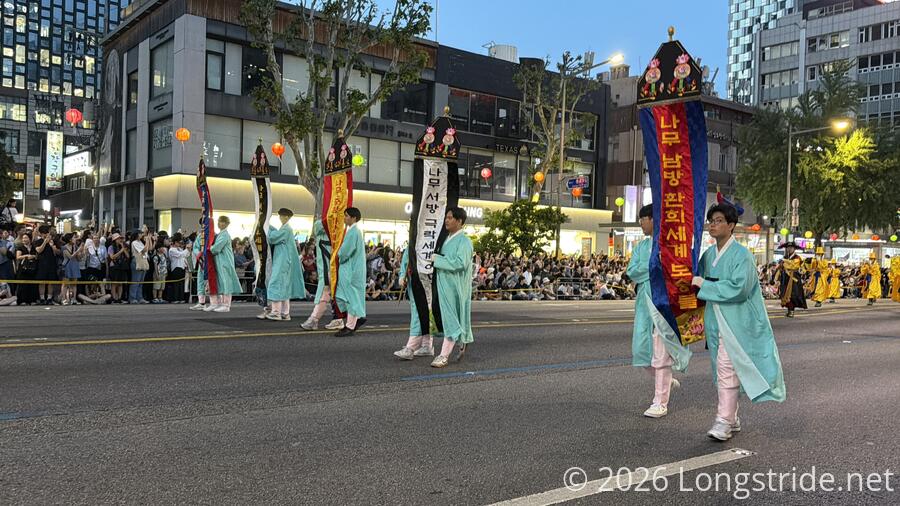
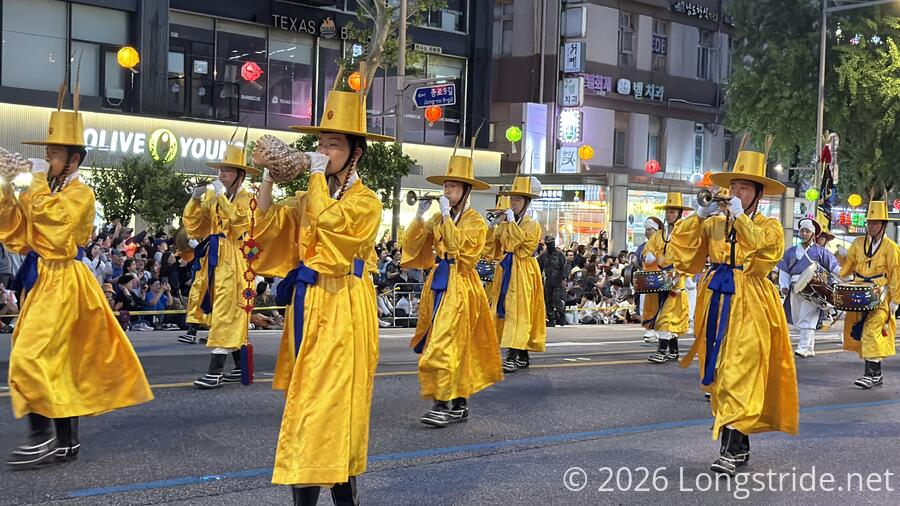
Shortly before the parade itself started, a group of musicians and dancers with traditional costumes and instruments did a performance (or maybe a warmup — they seemed to be in the parade when it came through) in the intersection just past where I was on the parade route, slowly working their way “backwards“ towards me.
By the time the parade reached me, nearly 8 pm, the sun had already set, though there was still enough light out to see. The front of the parade was more musicians in traditional garb, but they were quickly followed by large floats.
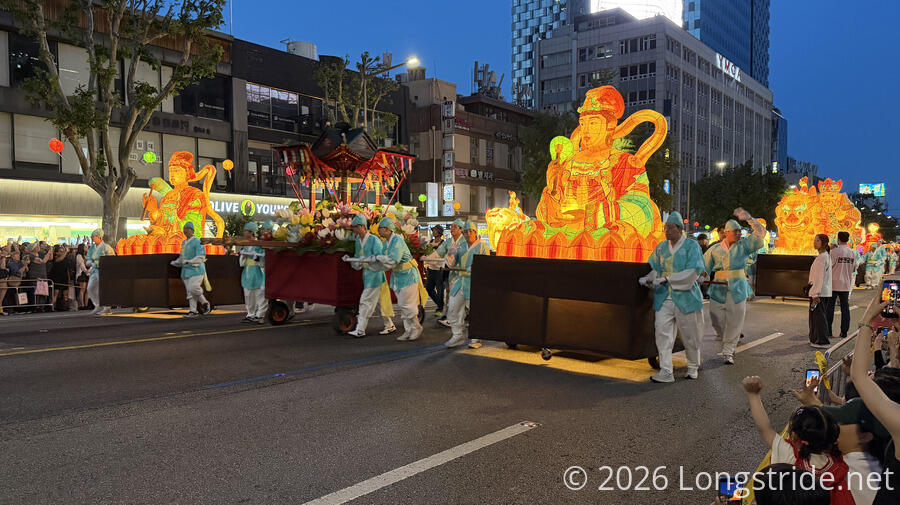
Most of the floats were people-powered: groups of four or more people pushed illuminated floats depicting figures and symbols of Buddhism.
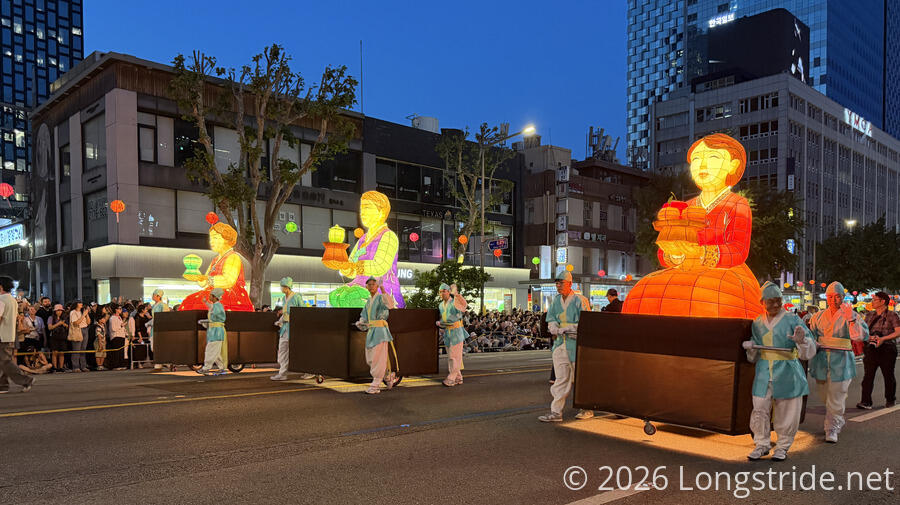
The floats were interspersed by members of different Buddhist temples in Seoul, each of which wore different costumes and carried different lanterns. Occasionally, a group of people would be dancing. (I assumed they must have danced in shifts so people wouldn’t have to dance for the whole length of the parade procession.) One group also had jugglers.
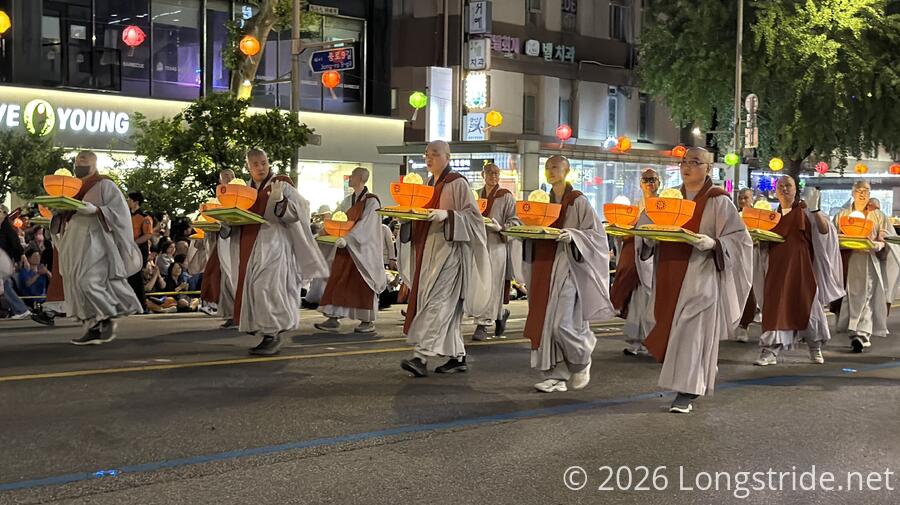
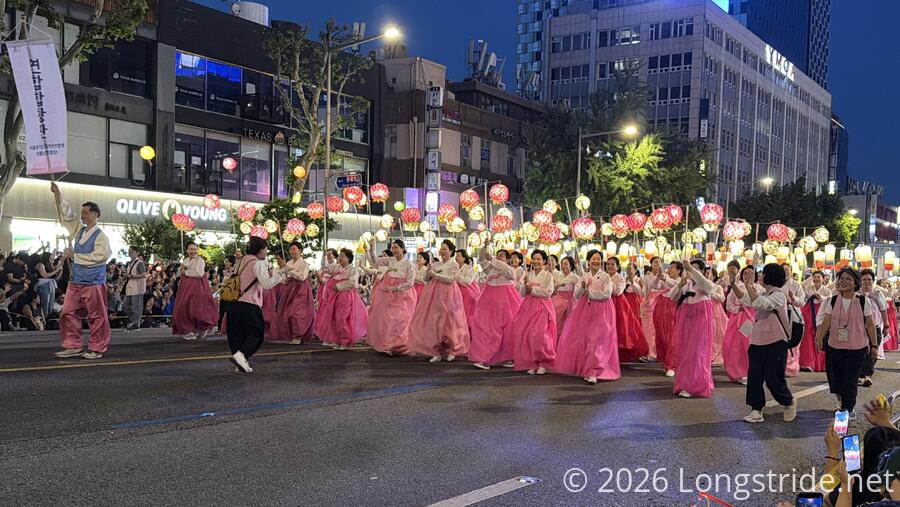
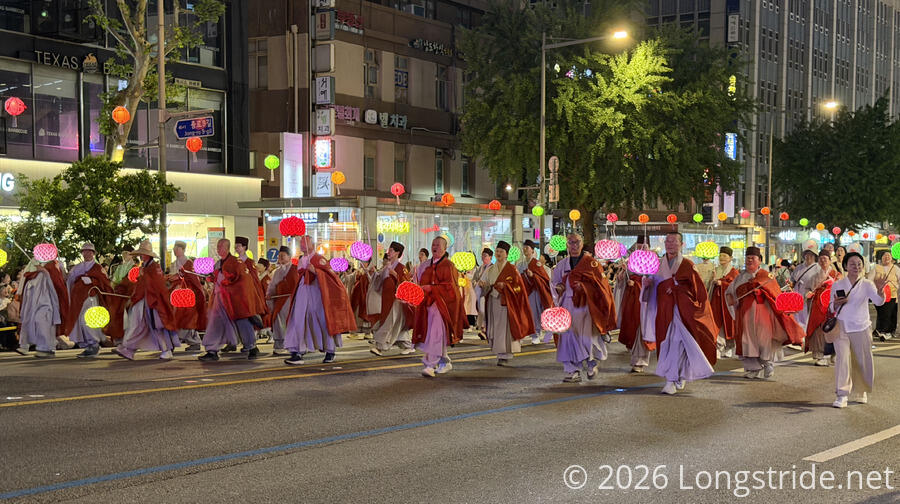
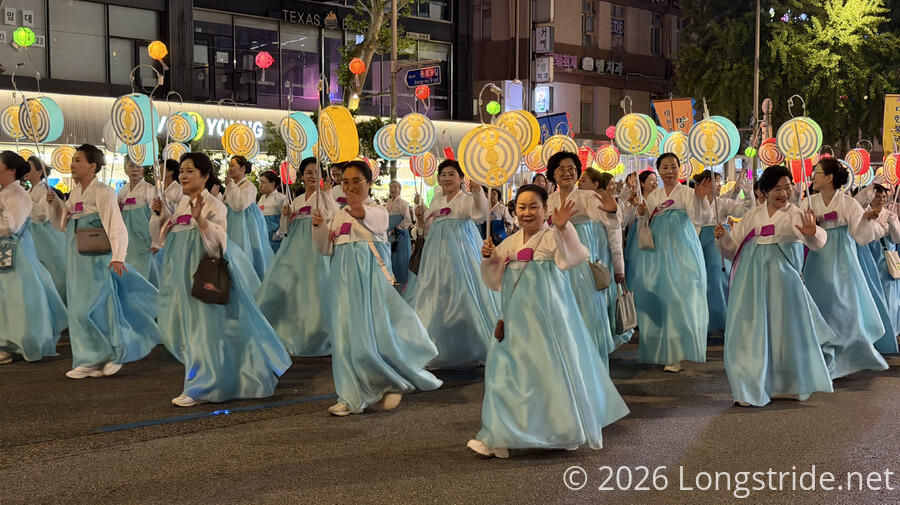
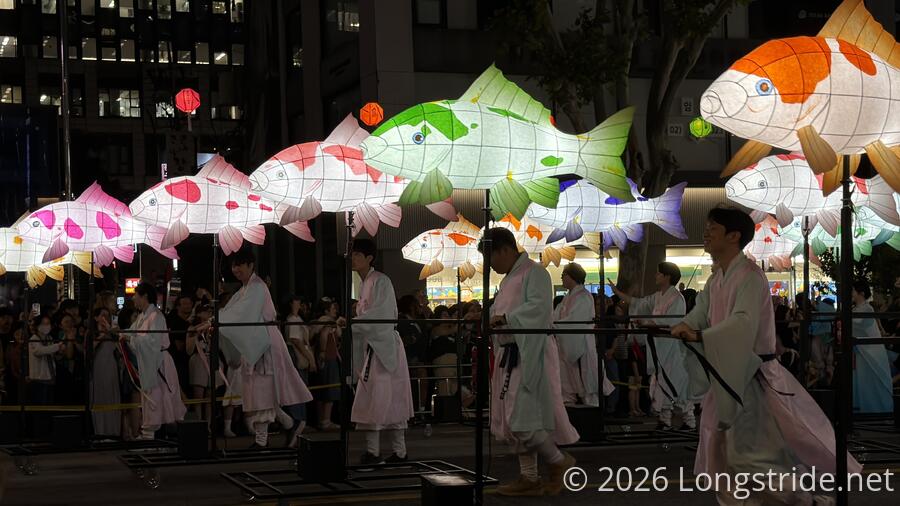
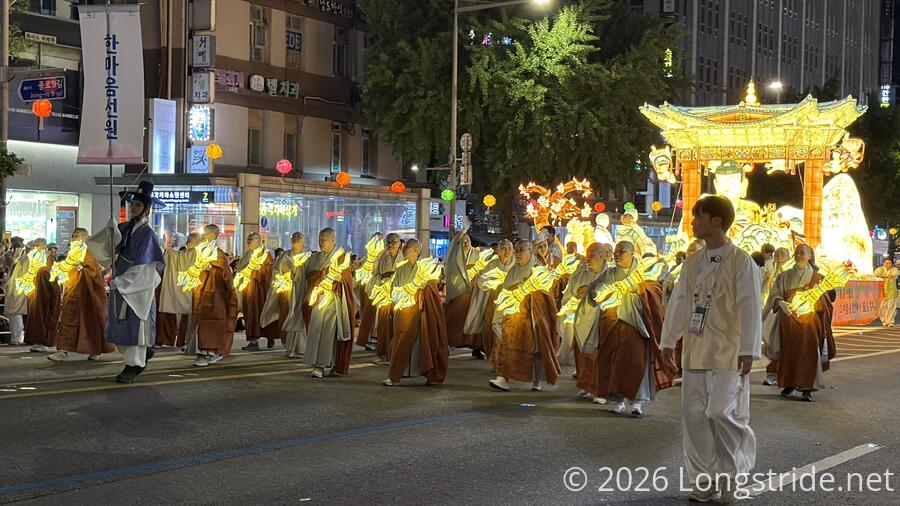
Besides the “official” groups, who had costumes, there were also several large “civilian” groups (with their own lanterns, most of which had a common design) in designated sections of the parade. It seemed as though anyone who wanted to march with the parade was able to, provided they had a lantern.
There was a fair bit of interaction with the crowd,
While most of the floats seemed to reflect figures and symbols from Buddhism, there were a few notable standouts. A giant mechanized lotus that opened and closed traveled with a fire-breathing dragon. Later, there was a fire-breathing peacock.
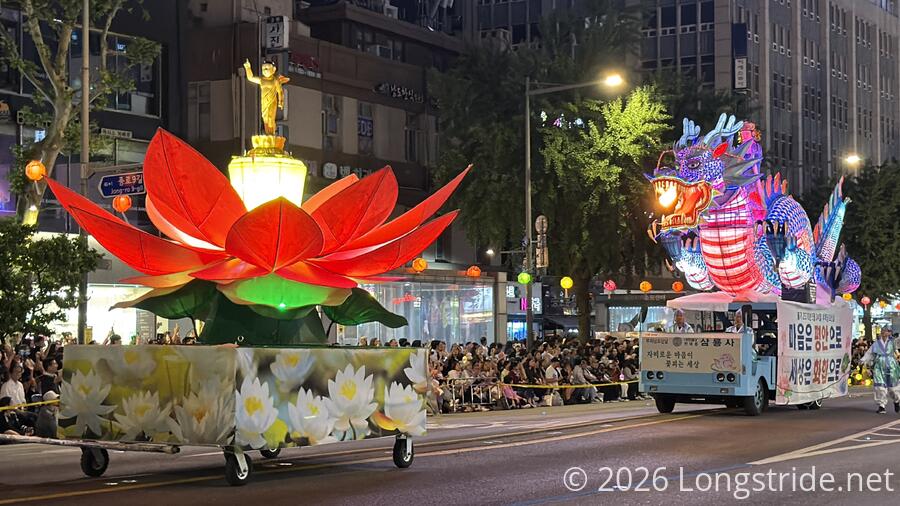
The parade was quite long; by 9:40, the parade was still going, though it was probably close to being finished. But my legs were exhausted from standing for over three hours by that point, and since I actually want to hike tomorrow, I called it quits on the festival and returned to my guest house.