A long road walk brought us to New Norfolk, and our last resupply on the Tasmanian Trail.
The morning started off warm. While that would normally help us get up and hiking faster, we weren’t in any particular hurry since we only had 22 km to hike today.
A sign at the entrance to the Bushy Park Showgrounds called out the nearby hops fields. Starting in 1806, attempts were made in Tasmania to introduce hops, to “eradicate the evils of the rum trade”, but hops farming didn’t really meet with much success until the William Shoobridge arrived in 1822, with expertise in hops growing in England (and some plants). In 1852, his son moved to the Derwent Vally, and this is when the hops industry began to flourish, allowing for an expansion to Bushy Park in 1867. This provided seasonal employment and drew people from all over Tasmania during the picking season.
From the showgrounds, CareFree and I continued east, with hops fields along both sides of the road. Almost immediately, we crossed the Styx River, and a short while after that, the Derwent again. Once passed the Derwent, the hops fields gave way to other types of farms.
Traffic was higher than usual for the Tasmanian Trail, with a fair number of large trucks on the road this morning. Fortunately, it seemed to be a short burst of activity, but the shoulders along the road wasn’t as wide as they have been, and the shoulder often was only passable on one side of the road.
About an hour after we left camp, we crossed a major highway (that’d take us back to Ouse, or almost to Bronte Park if we wanted), continuing straight onto Black Hills Road, a smaller road that quickly became dirt as it climbed towards the Black Hills in the distance. This road, it was clear, was not heavily trafficked: I walked through quite a few spider webs crossing the road, until a pickup truck came barreling through.
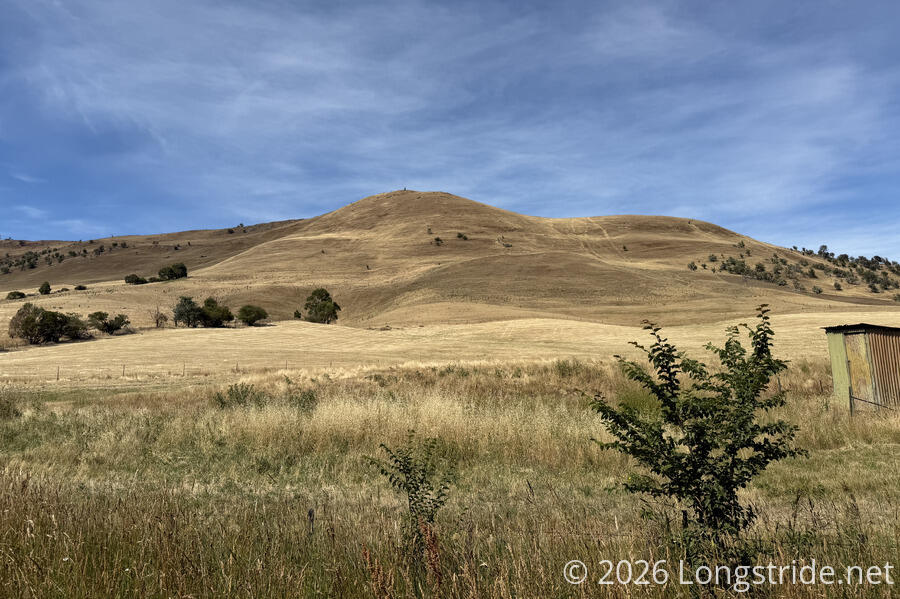
In contrast to the much greener scenery around the hops fields, these hills were drier, amber affairs.
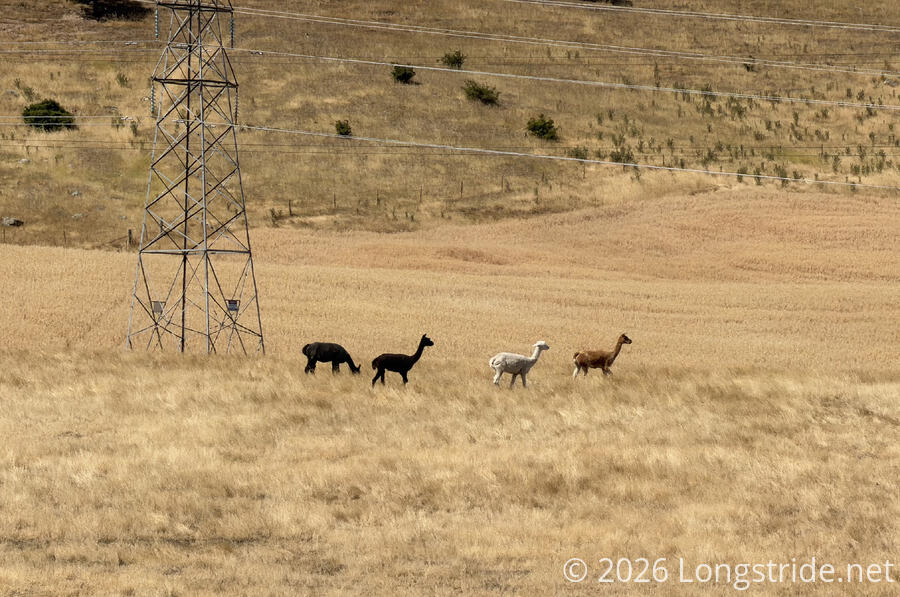
Of course we passed cattle this morning, but we also passed a farm that had a small herd of alpaca.
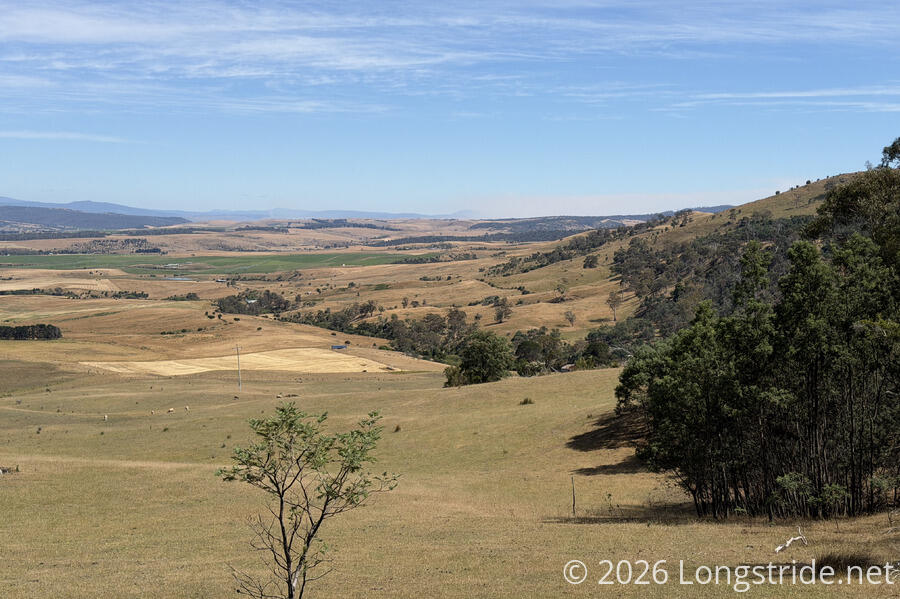
Once we left the Derwent and began to climb out of its valley, we began a nearly 500-meter climb over the next ten kilometers. Once we got high enough, we were able to see a smoky haze over the horizon, beyond the river. There were two fires, one much larger than the other, spoiling the otherwise largely clear skies.
Without much in the way of clouds (or trees) this morning, the sun was quite harsh, and especially once the climb got steeper, we were hot and sweating somewhat profusely. We got lucky to find shade under a few large trees besides someone’s house to stop for a break. Coincidentally, this was just a few hundred meters shy of a new milestone for me: 19,000 kilometers on long-distance trails.
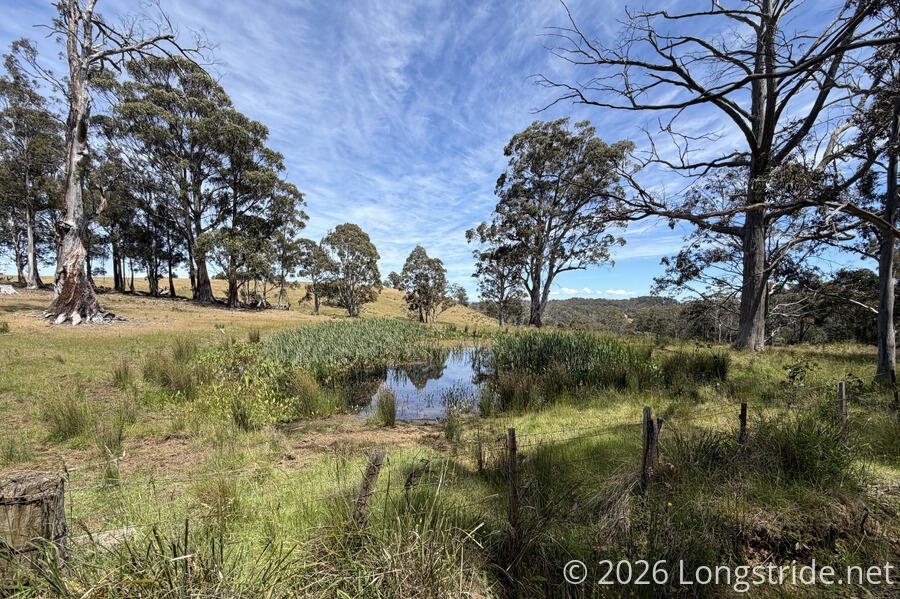
The road continued to climb, passing a few more isolated homes and farms. One farm had a large sign warning that all dogs on the property would be shot, which someone seemed to take offense of and try and (poorly) scratch it out. A few properties had nice ponds. One (with deer prancing around) seemed to go a little overboard, with a boathouse, a couple of docks, and several kayaks that seemed to be too much for the pond’s size.
Eventually, after one false summit interrupting our near-steady climb, we crested the Black Hills, and began a long descent towards New Norfolk. We passed a farm that had a pig on it. Shortly after, we passed “The Pork Hut”, a small shack next to the road that seemed to specialize in pig products. (It was closed, and the very many security cameras dissuaded us from peeking in the front door, or taking a break in its shade. We were able to find some shade further down the road to rest in, at a large bend in the road.)
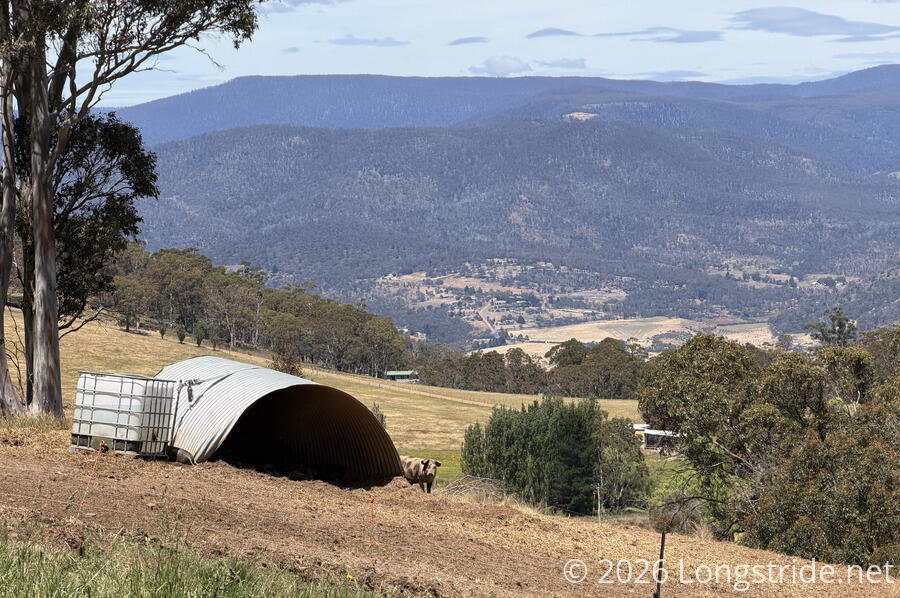
Getting further out of the Black Hills, we were able to get a better view to the south, and were able to clearly see Mount Wellington, the tallest mountain in the area, just outside of Hobart, Tasmania’s capital. (We should have been able to see Mount Wellington from Mount Bethune the other day, but it was too cloudy.)
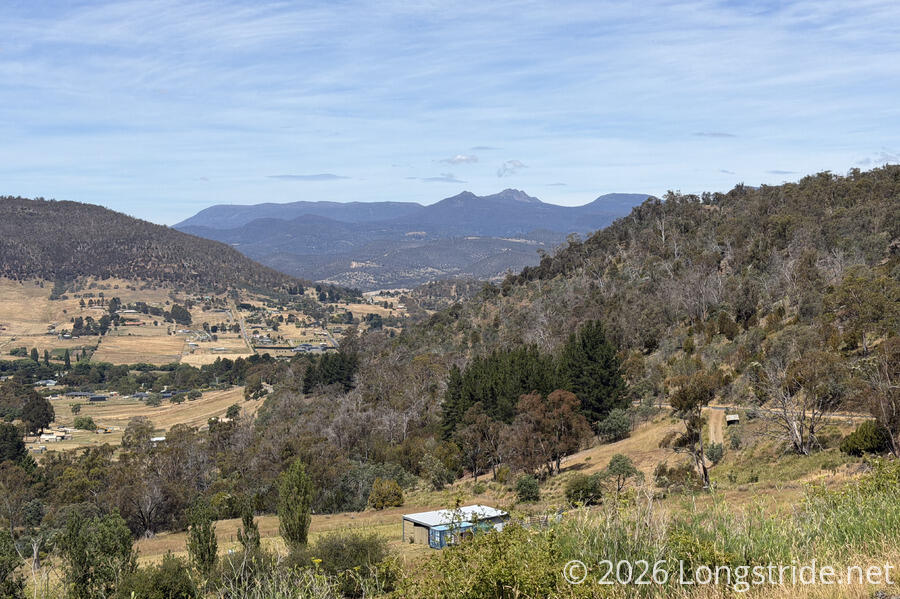
The long winding dirt road we had been on most of the day eventually became sealed, as we approached New Norfolk. We passed through an extended (for Tasmania) suburb, then crossed over the Derwent one last time, considerably larger than when we first crossed it two days ago, to enter the city proper.
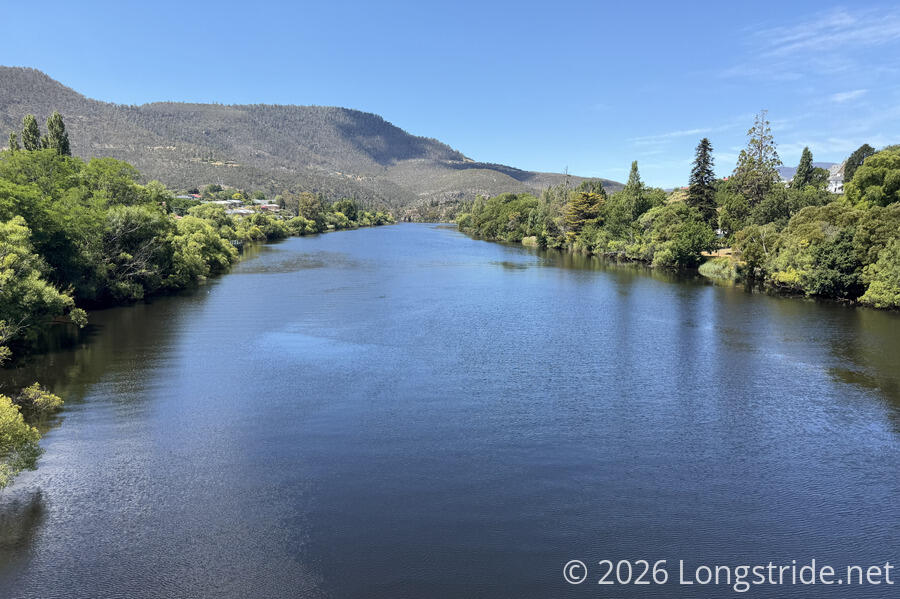
Once over the river, we turned off the trail to get ice cream and soda at a gas station — well deserved after a long hot day of road walk.
A little further down the road, we checked in to our lodging for the evening, the Junction Motel. Someone there clearly enjoyed decorating; the exterior looked as though a motel and a flea market had a head-on collision, with trinkets and artwork everywhere. (The trail has available free campground at a horse riding club’s grounds, which we chose not to avail ourselves of.) After showers, we walked to the Woolworth to resupply for our last stretch of the Tasmanian Trail, four days to Dover.
We had a very relaxed evening tonight, and won’t be in any rush tomorrow morning, since we’ll have a very short day: not even ten kilometers to Lachlan, the next town south. It’s not exactly a zero, but it’ll be a nice bit of a rest.