Leaving Latrobe, we made our way to Railton, and saw a platypus along the way!
We were a little slow getting started this morning, but with only 20 km to hike today, we weren’t under too much time pressure.
After a breakfast of pastrami-and-cheese sandwiches left over from dinner last night, CareFree and I left the caravan park a little after 9. Our first stop was the post office, where we boxed up and sent off our food to Miena. CareFree also sent off the new pair of shoes she bought in Adelaide; her current shoes have a little more cushion, which will help on the mostly-road “trail”, but they’re unlikely to last more than another couple hundred kilometers.
We also made one final trip to Banjos for coffee (for CareFree), hot chocolate (for me), and the excellent raspberry tarts we’ve gotten the last two days.
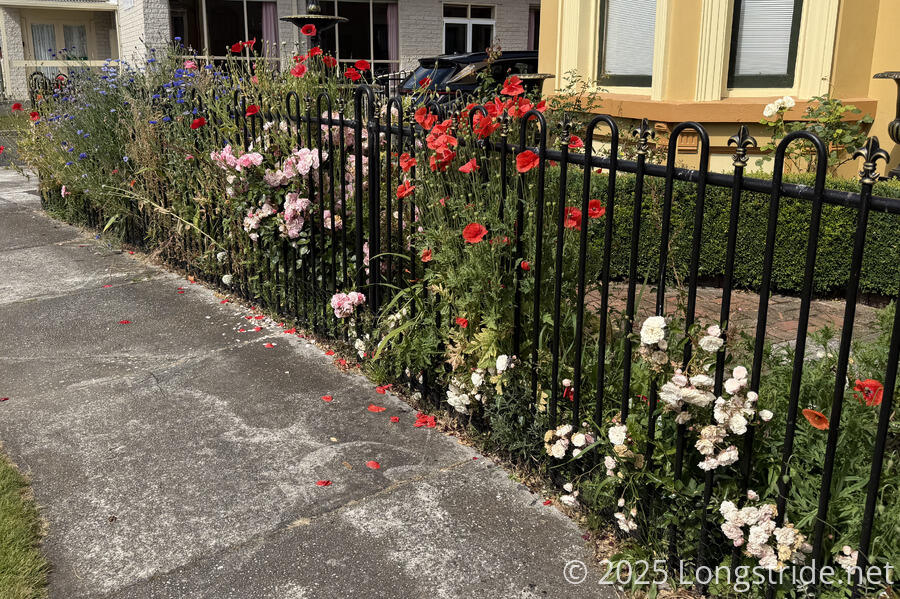
About an hour after leaving the caravan park, we continued on the trail, following sidewalks heading south out of Latrobe. Several of the houses we passed had quite colorful flowers growing on the fences facing the sidewalk.
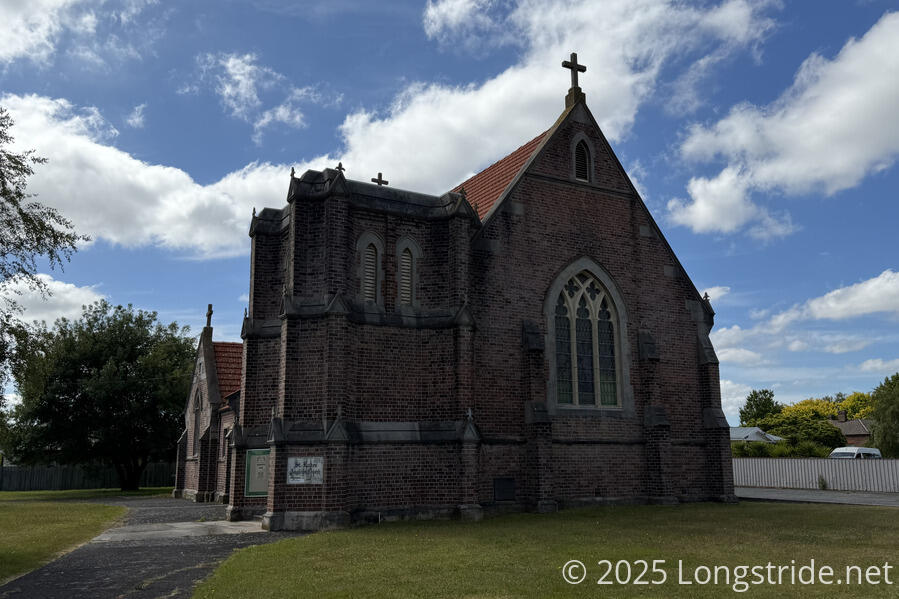
We also passed a surprising (to me) number of churches on our way out of town. It didn’t seem like that many would be necessary given the population of Latrobe, but I guess each denomination feels the need to own their own space.
We turned east, off a paved road and onto a gravel road. This turned us away from heading towards the Warrawee Forest Reserve, claimed by the Latrobe Council to be the “Platypus Capital of the World”. (Which is slightly aggrandizing, given that the platypus is only found naturally in Australia.) We’d hoped to see a platypus while on the Great South West Walk earlier this year, but never did, so this would probably be out next best chance. But platypuses are most active near dawn and dusk, so I didn’t hold out high hope to see one while hiking. (But we have to come back to Latrobe to get our stuff out of storage, so I figured that if we don’t see one, we’d have another opportunity later to make a concerted effort.)
We’d already seen several dead wallabies on the side of the road, particularly yesterday on our way back from the storage unit. While we were walking up the gravel road, one hopped across the road right in front of us. We briefly entertained the thought that they must be stupid (being that there were so many flattened ones next to the road), and that it’d be funny if they were so stupid as to hop across a road directly into us. (Clearly, there’s plenty of room for wallaby-themed “Why did the chicken cross the road?” jokes.)
In contrast to yesterday’s dreary weather, it was bright and sunny out, with some clouds to lightly mediate the sunshine. It’s a good day for a hike.
The trail crossed a barrier, entering a partially-logged eucalyptus forest. On the ground, we saw footprints and bicycle tracks. In contrast to our recently-completed hike of the Walk the Yorke, in which we saw no signs of anyone else on the trail, this (plus the people we saw along the cyclepath between Devonport and Latrobe) gave us confidence we would actually see other people (probably cyclists) on the trail.
The trail is also giving me some New Zealand vibes. The trees (and animals) are all wrong, of course, but it’s bright and clear out, with intense colors.
While on the a eucalyptus plantation, we passed three people on motorbikes. A short while later, we stopped for a break, seemingly at the end of the plantation, where the trail left the dirt road and became a nice, shaded hiking trail through a pine forest. As we were getting ready to continue, two more cyclists biked past on the road.
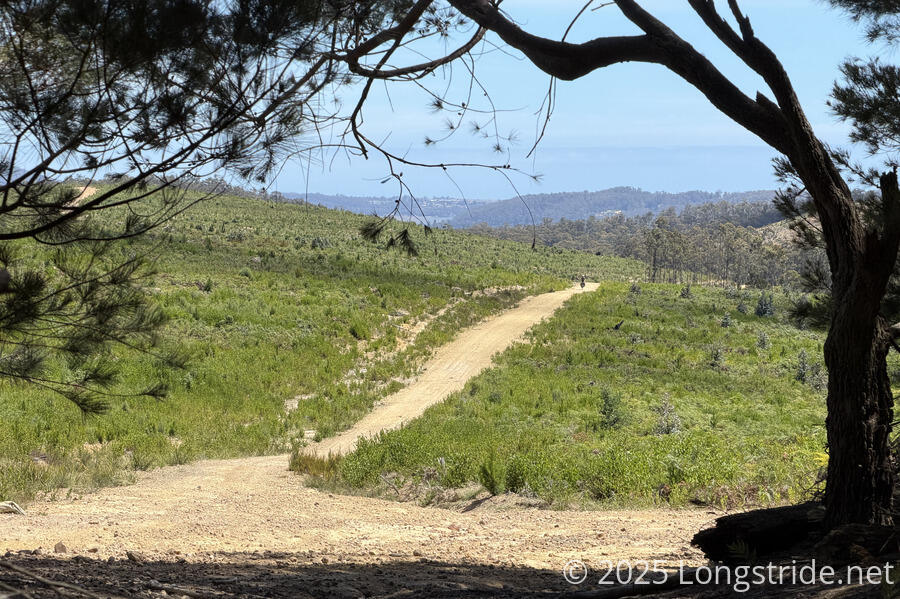
While much of the Tasmanian Trail is on public land (or roads), it also passes through some private property. In some cases, the arrangement made with landowners by the Tasmanian Trail Association is that access to some of the private property is by members of the association only. Some of this access requires a trail key obtained from the association to unlock locked gates.
About ten minutes after our break, we reached the first of these locked gates. Coincidentally, the two cyclists we saw arrived at the gate at the same time, evidentially having taken a wrong turn. We only chatted with them briefly enough to determine they’d hastily planned their cycling trip, and didn’t have time to get a key. They were already gone before I could get the lock — which was a bit rusty and hard to operate — shut again.
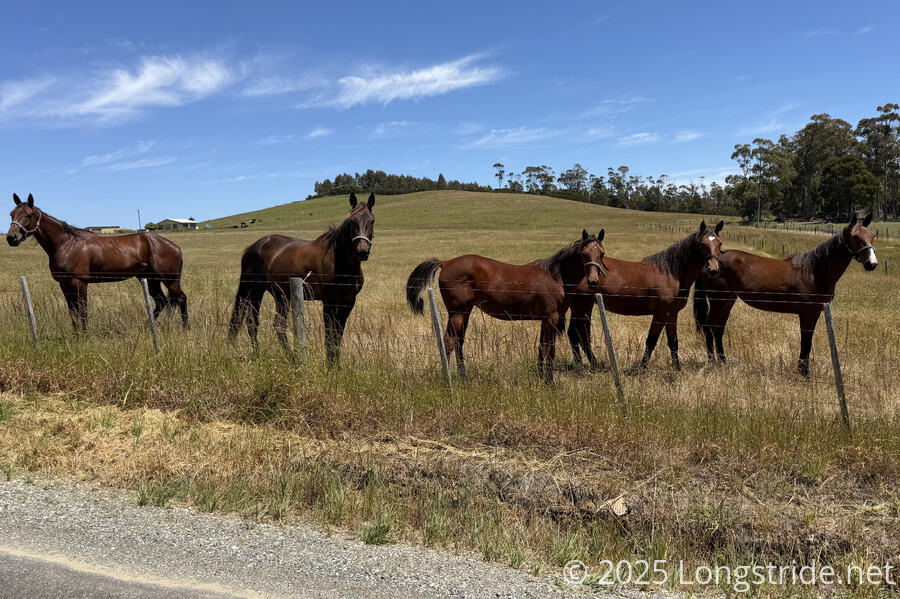
The trail followed a narrow, overgrown path between a driveway and a field with five horses, who took a very keen interest in us. (Fortunately, both an electric and barbed wire fence kept them in their pen.)
Another locked gate, this one easier to unlock and lock, guarded access to the road. The cyclists had already hefted their bikes over and were gone before we got there.
The rest of the day, we were on paved roads, mostly along various farms. On one, a large (hundreds of meters long) mobile water sprinkler was slowly working its way down a field, leaving a giant rut where the soil was a bit waterlogged.
A later field, fenced off with barbed wire, had a sign on it, “Danger - Prohibited Area - Poison - Keep Out - Illegal use of crops has caused death.” The sign sponsored by Poppy Growers Tasmania, Inc clearly answered the question I didn’t have about what was growing in the field.
This area felt like the walk towards Pelorus Bridge on Te Araroa, with a long roadwalk through farmland, with mountains peeking up in the distance down a valley.
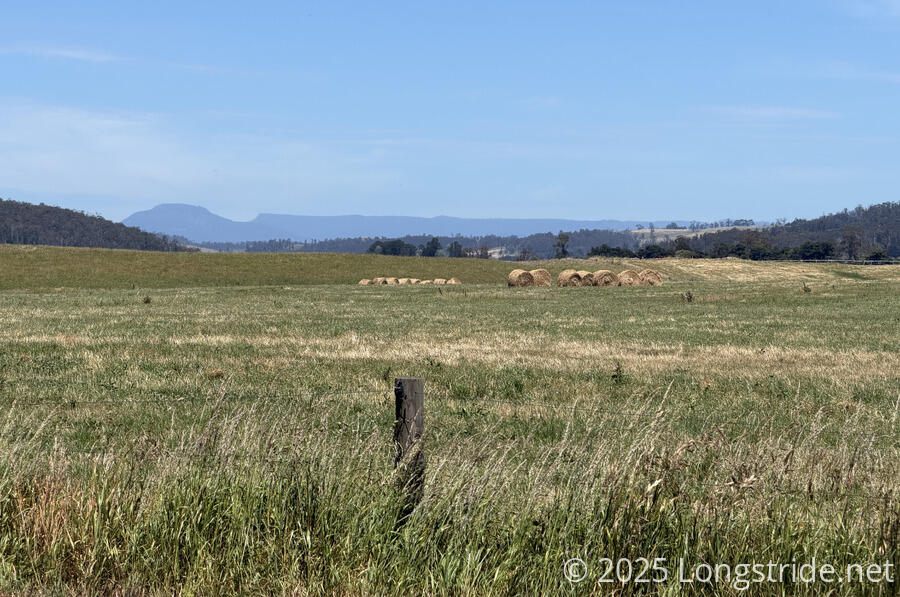
Both this morning and this afternoon, we passed by a few cow farms. Some of the cows seemed very interested in us, and came as close as they could within their enclosures.
We crossed the Mersey River again. Now many kilometers upstream, it’s much smaller than it was when we followed it from Devonport to Latrobe two days ago. In two more days, we’ll camp at the river, and then ford it the next morning.
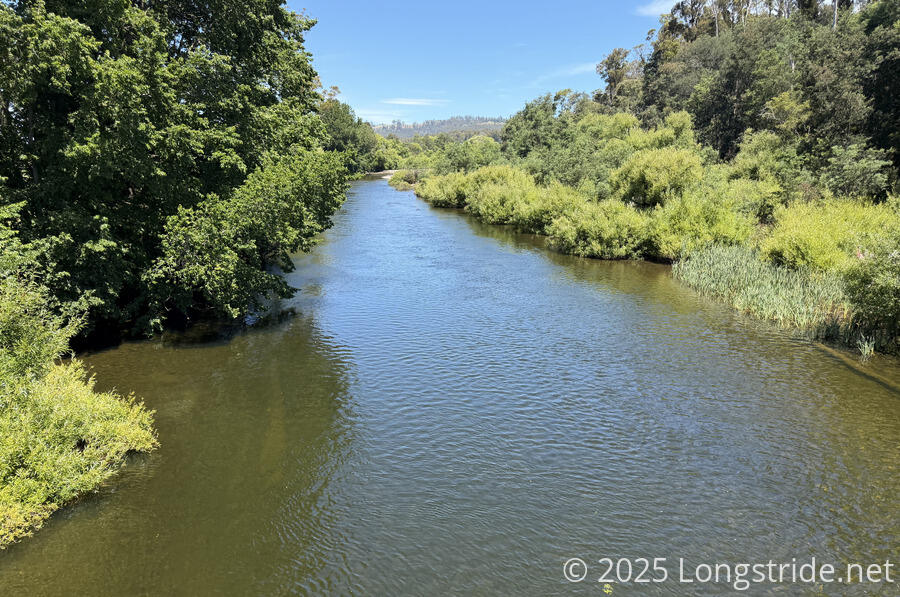
By pure chance, crossing the bridge over the river, we saw a platypus, swimming from a small cutout on the river’s left bank towards the bridge. I missed getting a good photo of it the first time we saw it, but we waited around for another twenty minutes as it repeatedly dove under water and came back up for air, eventually getting a reasonably good picture of it.
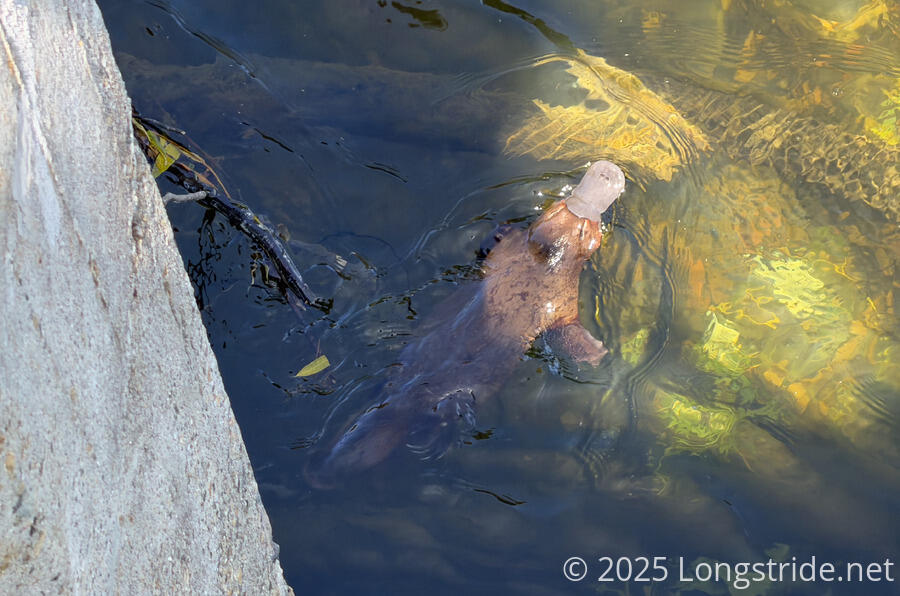
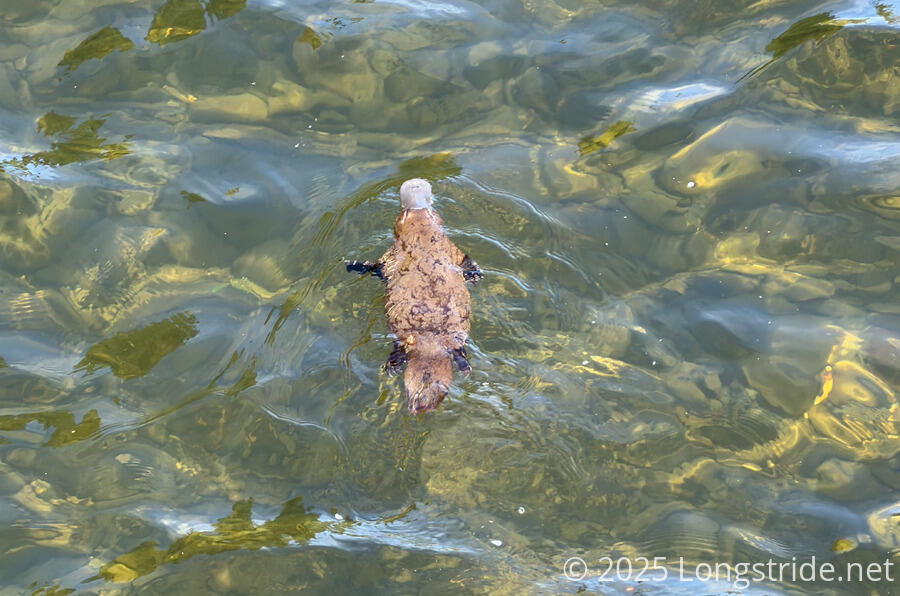
While we were looking off the bridge, a local driving his car stopped, wondering what we were doing. We said there was a platypus down there; he replied that most Tasmanians don’t ever even see a platypus in the wild, so we should count ourselves lucky!
We reached the outskirts of Railton around 3, following sidewalks to the center of town. We missed the local cafe by an hour — normally open until 3:30, they close at 2 this week because of the holidays. We instead got our ice cream and soda fix from the gas station and general store, which was surprisingly well stocked. If a hiker wasn’t picky, a full resupply could be done here.
After eating our ice cream, we walked back to the Railton Hotel, our lodging for the night. It’s an old building, which on the one hand is fine, it means a place likely has character. Unfortunately, the character here is tired. While we got a nice-sized room (though with shared bathrooms), I’m not really sure the quality of the room and its furnishings were commensurate with the price we paid. (There’s seemingly fifty- or eighty-year-old furnishings in the room, which I’m sure are very unhappy with our wet towels hanging on them given the typical lack of anywhere to hang anything that most hotel rooms have.)
After quite refreshing showers, we had dinner in the common room: ramen soaked in hot water from the electric kettle. (We tried the pizza place the hotel’s owner suggested, but it seems out of business. When I called, I got some guy who was probably not happy to have the number of a former pizza place.)
Later, after dinner, two freight trains went through on the railroad tracks a short distance from town, seemingly carrying goods to the Devonport terminal.
Tomorrow, we’ll have a nice, short day to Sheffield, where we’ll load up on five days of supplies and begin a series of much longer days as we head further south.