An unexpectedly tiring day took us to the Old Liffey School, between Liffey and Bracknell.
With only 21 km planned for the day, we were in no pressure to get an early start. We slept in, which seemed like it was much needed, and only got up almost at 8 am. It was cool out, and clouds hung over the nearby Quamby Bluff, just enough to put its top in fog.
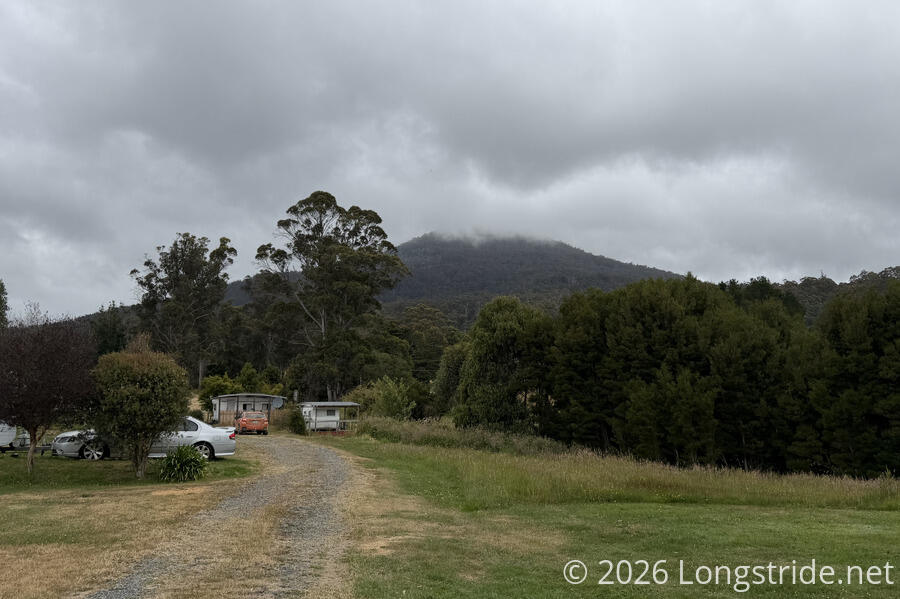
On the other side of the area set side for tents, a gate led to a farm track. A cow stood on the other side of the fence, watching us.
We left Quamby Corner shortly before 10, continuing yesterday’s roadwalk. Only ten minutes later, we were passed for the third time (including twice yesterday) by the same white “Where’s Wally Cleaning” car. Apparently, we have a stalker.
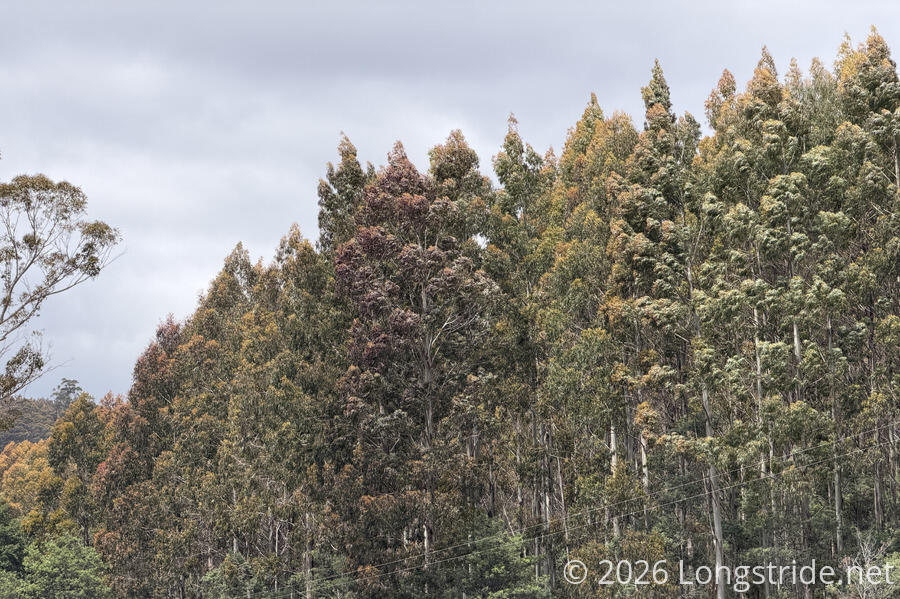
Over the last couple of days, but especially today, we’ve noticed that the eucalyptus trees don’t have their leaves in a (mostly) uniform green. Some of them have leaves that take on red or yellow shades. This was surprising to us, since we didn’t notice this on either the Great South West Walk or Great Ocean Walk, and because eucalyptus trees are evergreen.
Unlike our mostly nice weather so far, this morning was overcast, and somewhat humid. Somehow, our tent wasn’t wet in the morning, but it didn’t take much hiking before we were. We had a nice downhill for about fifteen minutes, but after that, we were mostly uphill for the rest of the morning. With the humidity, the sweat poured out, drenching out shirts.
The trail took us towards and then along the northern face of Tasmania’s Central Plateau, which we’ll ascend tomorrow. Clouds seemed to blanket the plateau, or at least, its rim.
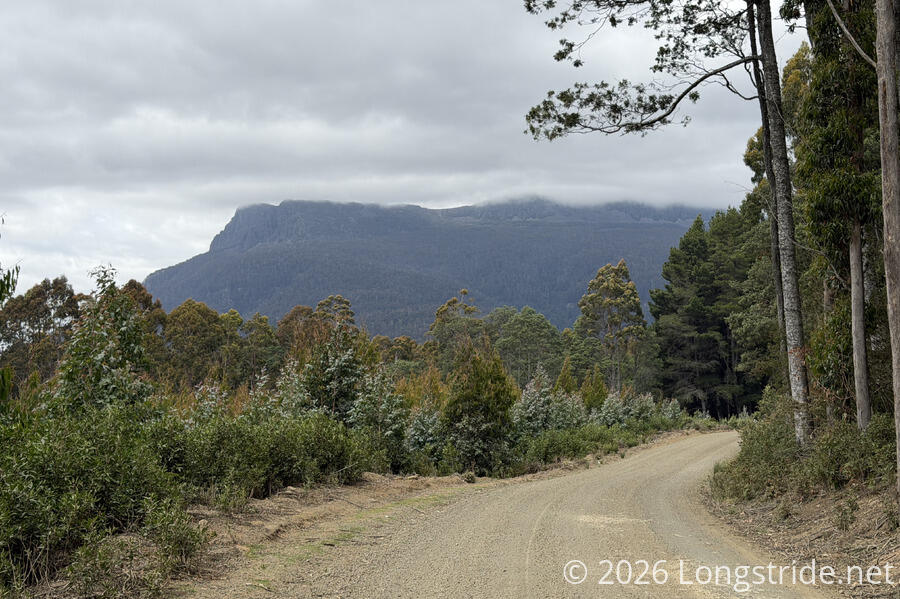
The day was a mix of farms and forest. After leaving the caravan park, we circled around a farm, then began ascending on a gravel road, heading to a mix of forest and farms.
We passed one field that probably had a dozen or two wallabies foraging among the bush; as they noticed us, they all hopped away, one at a time, heading along a fence line towards forest.
At some point, we entered the Liffey State Forest. At the occasional road junction, signs called out a Tourist Route, apparently one-way and in the direction we were going. Nevertheless, quite many cars were driving the other way, towards us. I guess they weren’t tourists.
We only knew we were in the forest because there was a sign as we exited. Someone took exception to the maintenance of the forest; the adulterated sign read, “Liffey State Forest, a multiple use area [poorly] maintained by Forestry Tasmania”.
As we descended, we gradually got closer to the Liffey River. Initially, it appeared to have a fairly deep rocky channel, though the water itself only used a small portion of its channel. When we got closer to the river, we noticed evidence of a flood in past years, with erosion high above the bank, and at one bend in the road, a rock retaining wall built up from the river level. Coincidentally, CareFree had been listening to a podcast by someone who hiked parts of the Tasmanian Trail in 2021, who had multiple issues due to high water levels and flooding. I wouldn’t be surprised if this was related to the flooding of the Mersey River that the Northern Coordinator told us about two days ago.
Many of the homes along the road also looked nicer and newer than we would’ve expected. If they had been damaged or destroyed in a flood four years ago, there’d certainly have been time to rebuild them by now.
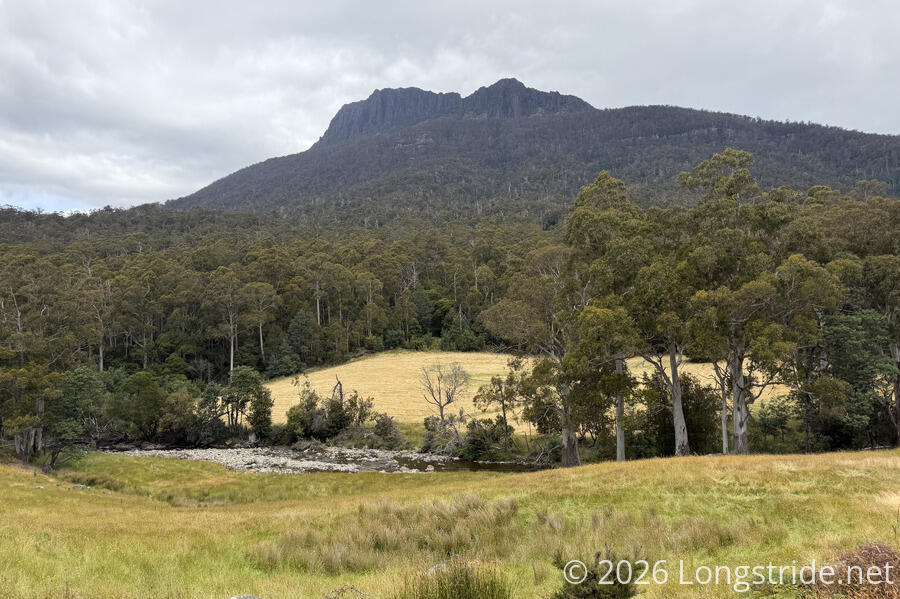
The rest of the afternoon was not very memorable. More homes, more farms, the occasional herd of sheep or cows. The cows generally still seemed interested in us, though we didn’t get whole herds following us like yesterday.
A little after four, we arrived at the campsite for this section, the grounds of the Old Liffey School, now used as a town hall. The building was locked, but a pair of toilets in an outbuilding and water from the rainwater tank was available. A few picnic tables and benches rounded out the amenities, along with views of the surrounding farms.
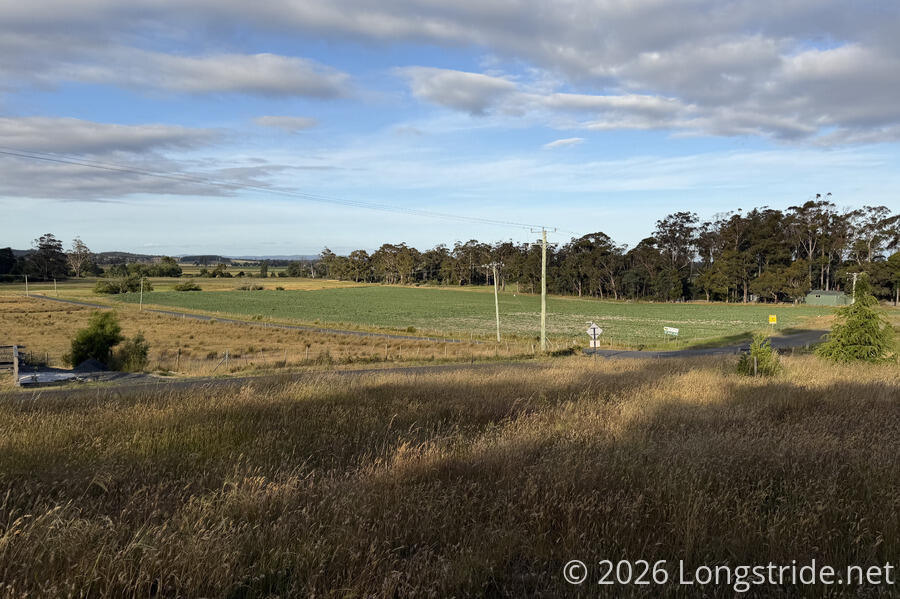
When we arrived, a camper van was parked on the lawn already (though no sign of its people). Later, a cyclist passed, heading north, and two trucks, one with a caravan in tow, showed up. At that point, we quickly set up our tent, claiming a flattish area near “our” picnic table before too many other people showed up. Only one other car arrived later, at nearly 8. By then, it had gotten a little windy and chilly, and we had already retired to the shelter of our tent.
After dinner, we called the Great Lake Hotel, where we’re supposed to be in two nights. Because we’re uncertain how far we’ll get tomorrow, or if we’ll split up the 40+ km section to the next campground into two days, CareFree called to try to make arrangements for that. The hotel seems to be very flexible: they blocked off the cabin we booked for an extra day, and if we don’t show up on Sunday like we expected, then we’re still good for two nights. (Apparently also, there’s no cell reception at all on that part of the Central Plateau; the cell towers were taken down for upgrades, which have been delayed until later this month. Seems unusual, but, it is what it is, I guess.)
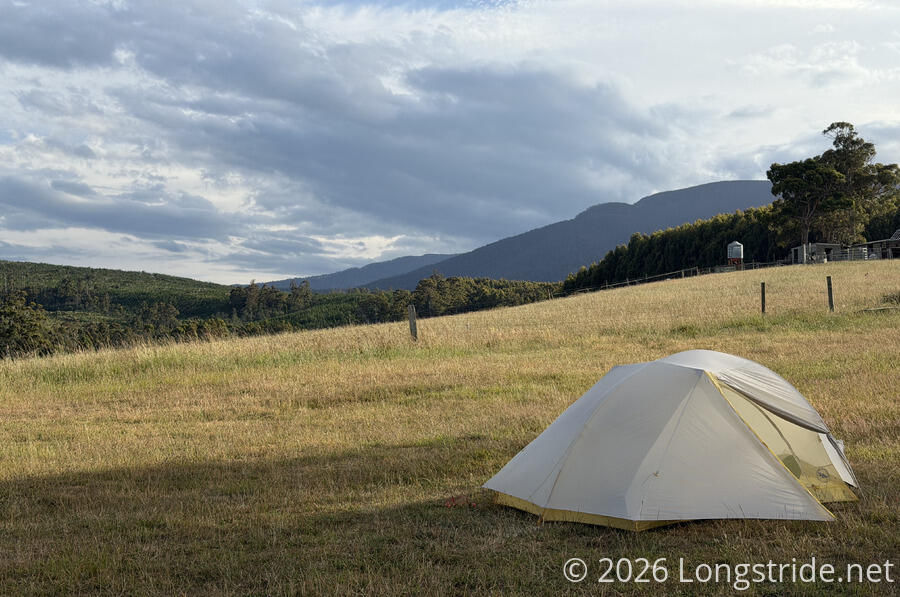
As the sun set, the sky seemed to continue to clear. Hopefully that’ll mean good weather for tomorrow!