Most of my hiking has been on wilderness trails. And while I’m quite happy to keep doing that, I wanted to add some variety, and do a hike that was a bit more cultural. This led me to the Tasmanian Trail, which is very much not a wilderness trail. Rather, it’s a walk (or cycle, or horseback ride) through the center of Tasmania, along backcountry roads and through a dozen or two towns and communities of various sizes.
Given that a substantial portion of the Tasmanian Trail is on backcountry roads, I wasn’t expecting a lot from it, and I initially set my expectations low. Rather, I was viewing the trail as a convenient way to go somewhere relatively few other hikers do. (Especially considering some of the trail is on private land that can only be accessed with permission.) But, the trail turned out to be more interesting than I expected, and I enjoyed it a lot more than I thought I would. Read on to learn more about why that was.
In Comparison With Other Trails…
Immediately prior to the Tasmanian Trail, my partner and I hiked Walk the Yorke, a coastal trail that closely follows the coast and many of the beaches of the Yorke Peninsula in relatively nearby South Australia. This was the last of four coastal trails we hiked in 2025, including the Great South West Walk and Great Ocean Walk (both also in Australia), and the East Coast Trail in Newfoundland, Canada.
The East Coast Trail, a combination of wilderness and community walk, was part of the inspiration for hiking the Tasmanian Trail. The two trails aren’t entirely dissimilar: they both directly link many towns together via a walkable path, though the Tasmanian Trail is a bit more rural and bucolic in its setting, usually connecting towns via dirt road, rather than wilderness trails.
On last year’s trails, we were inundated with ocean. On Walk the Yorke, it was a rare day when we didn’t have the ocean in near-constant sight. And while I did enjoy that trail, there was a substantial sameness along the trail interspersed with a few pockets of delight. (You can read more about my thoughts of Walk the Yorke in my post hike summary.)
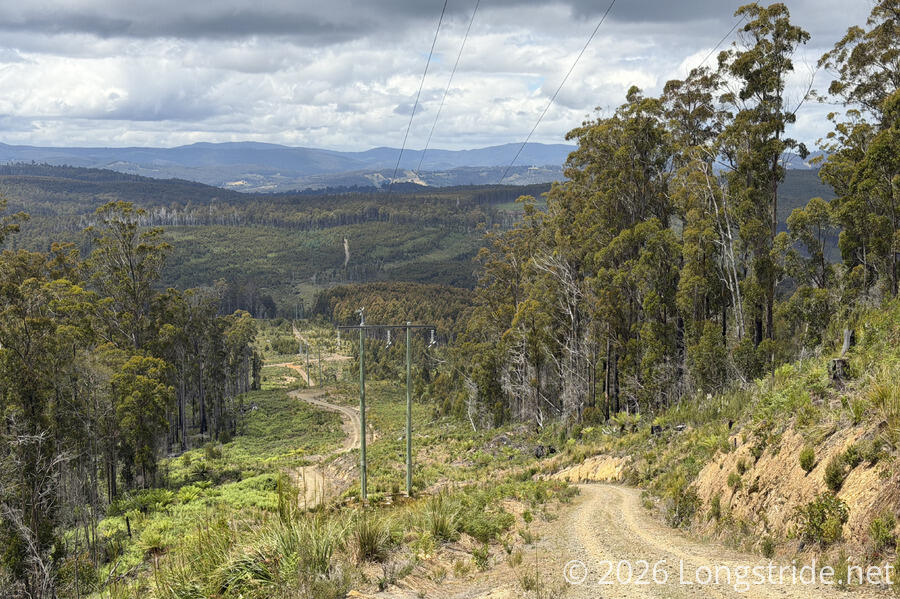
Tasmania was much different: we walked through a wide variety of landscapes. Lush green landscapes, even, in stark contrast to the sand and dried-out farms of the Yorke Peninsula. After seeing the ocean nearly constantly, we saw the ocean when we started in Devonport, and as we finished in Dover, and otherwise not at all for nearly all of three weeks. Three weeks of nearly-flat trail on the Yorke turned into rolling hills and a strenuous hike up to Tasmania’s Central Plateau, which was a fantastic change of pace. A few days later, the hike south of Miena took us through a (very windy) alpine plain that was rather unlike anything else I hiked through last year.
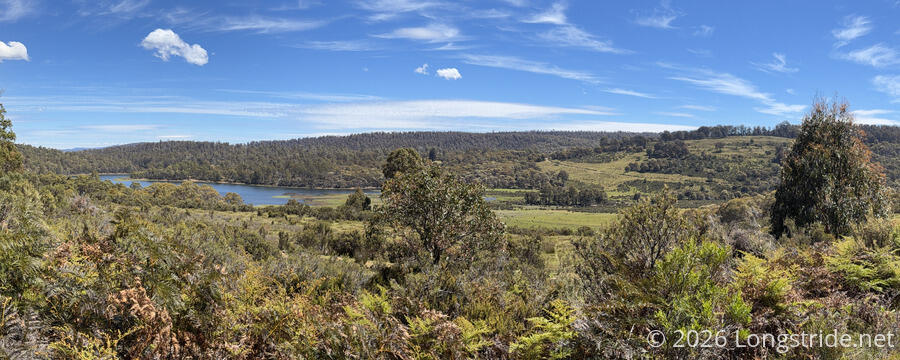
The Central Plateau, in particular, took us on a tour around much of Tasmania’s hydropower infrastructure: reservoir lakes, water intakes, pump stations, pipelines, power lines, and water flumes all crossed the trail or were nearby. We even had a detour at one of the flumes due to maintenance that had just started.
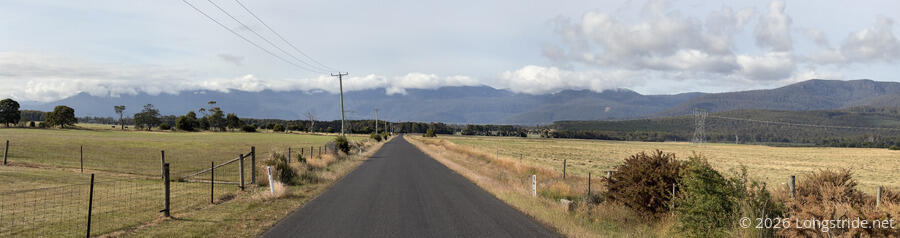
Though the Tasmanian Trail does not go through Tasmania’s impressive national parks, there is enough variety that made the scenery worthwhile. And I think this is why I liked the Tasmanian Trail as much as I did. After a year of coastal trails, I really needed something different, and Tasmania delivered well.
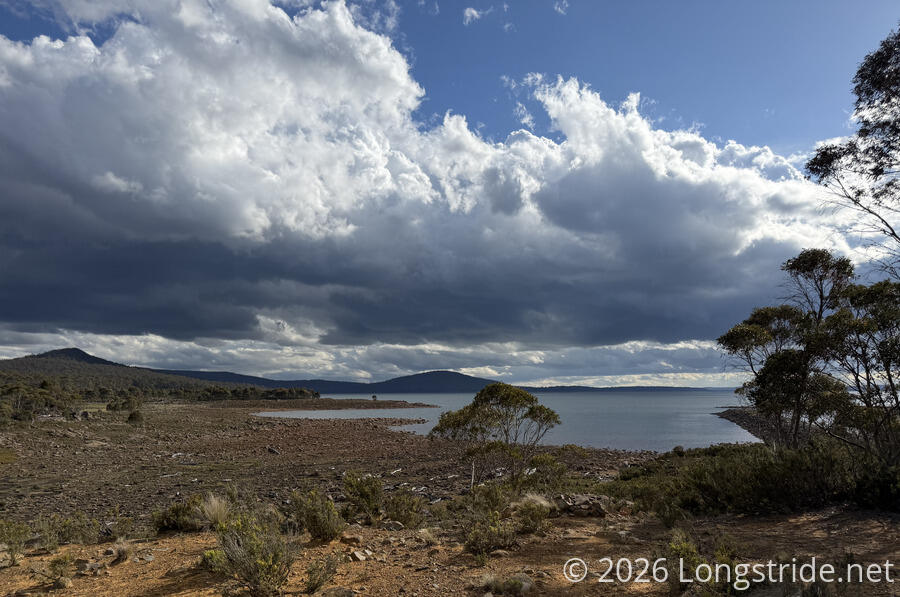
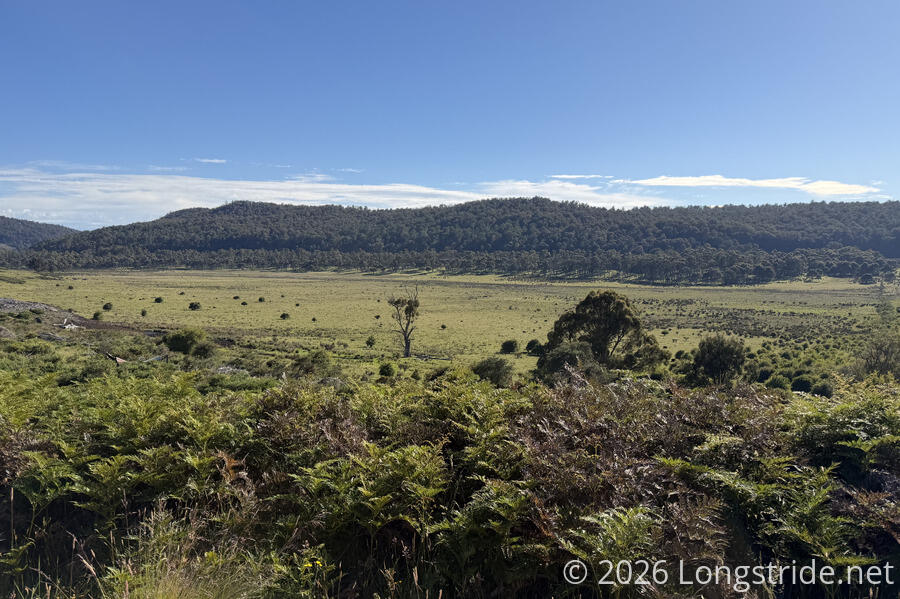
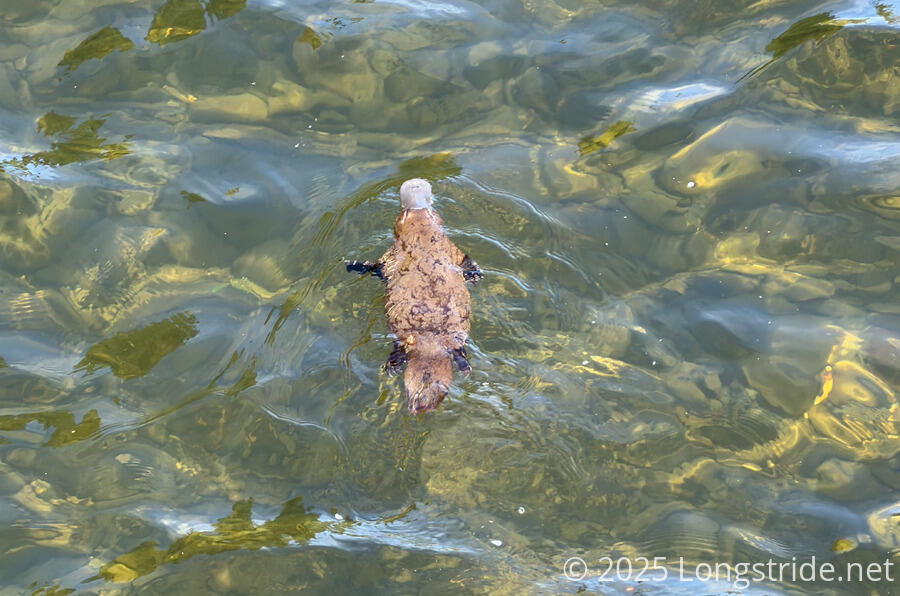
Tasmania also felt alive, in a way the Yorke didn’t. Outside of town, we hardly saw anyone else on either trail, but the towns in Tasmania were much more active. That we were often surrounded by green landscapes also helped. On the York, inland from the dunes, the farms, on pancake-flat land, were a dry, dusty brown. In Tasmania, everything was alive (including, in a roundabout way, the rather shocking amount of roadkill). We got lucky and saw a platypus, adding to our list of iconic Australian animals. Often, especially in the north half of Tasmania, cows on farms all hurried to follow us as we walked along the trail.
A Trail of Roads
In general, the Tasmanian Trail wasn’t terribly difficult to hike. The only particularly hard sections were off-road sections, including the hikes up to the Central Plateau, and Mount Bethune, and they were only hard in relation to walking on a road. In the grand scheme of long-distance trails, the Tasmanian Trail is pretty easy to walk.
Actually, I found the trail’s dirt roads to be surprisingly well-maintained. A lot of dirt roads on other trails are often rutted, or filled with divots and washboards, but the Tasmanian Trail offered very little of that.
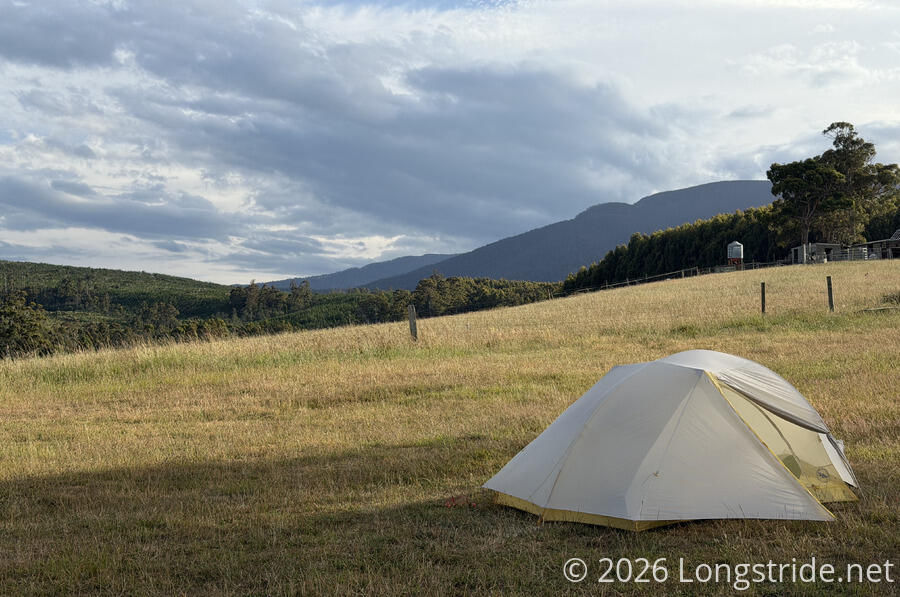
What was challenging, though, was that the road-centric nature of the trail significantly limited the number of places one could camp. Often, we had to adhere to the sections as defined by the Tasmanian Trail Association. Each section had some kind of camping (often, but not always, free of charge) available at their ends. There’s a certain freedom that comes with being able to decide to stop for the day when you feel like it. But, since this trail is not a wilderness trail, there were generally very few chances to wild camp. This isn’t intended as a criticism of the provided campsites. The campsites we used were all fantastic, and it’s absolutely great that they’re there, and I appreciate them, even as I wish there were more places to camp.
Trail Routing and Logistics
The trail also has slightly complicated logistics. To even get the trail’s guidebook and full route description, you have to join the Tasmanian Trail Association. To hike the trail as described in the guidebook, one also has to obtain a trail key from the association. The trail key provides to access some padlocked gates, campsites, and restrooms. A few of the official campsites and one stretch of trail required permission to be obtained by phone in advance. This is quite unlike any other long-distance trail I’ve hiked. To be clear: I’m not complaining. The cost of membership and the key are rounding errors in the cost of just getting to Tasmania, and help to support the trail. And I’m fully supportive of contributing to the maintenance of the trails I hike. And if private landowners require trail keys or explicit permission to access their land, well, that’s much better than not being able to access that land! (One of the best campsites I’ve ever stayed at was on private land.)
There were a few places where I felt the trail was harmed by its intention to support equestrians. Between Latrobe and Sheffield, for example, there is an extensive network of cycle tracks and hiking trails through forest reserves. But the Tasmanian Trail goes out of its way to avoid nearly all of it to stick to roads (which adds a section through private property and two uses of the trail key). Which is why later, it feels a little weird that the trail skips the road to go through private property to climb Mount Bethune. But that, and the stretch the same day through the Meadowbank Private Forest Reserve, and the relatively high-elevation meadows on the farm just after, were among my favorite sections of the trail, so that’s not so much a complaint, as an observation of an inconsistency in the trail’s routing.
The trail’s termini have potential, but as they are now, I’d rate them among the worst of trails I’ve hiked. The northern terminus, in Devonport, ostensibly at the ferry terminal, didn’t have any kind of sign marking the end of the trail. (Though there was some construction going on, so it’s possible the terminus was obscured or temporarily removed.) In Dover, rather than end somewhere at the waterfront with excellent views of the Port Esperance harbour, the trail jogs through town a little to end at a sign, literally on the side of a road with no sidewalk, across from some homes, and adjacent to (but not in) a memorial park. (On the plus side, at least the trail ended within sight of several restaurants, including a pizza place, so we got a good post-hike meal there!)
Overall, A Fine Trail
While I wouldn’t necessarily rate Tasmanian Trail as one of the best trails I’ve hiked, I enjoyed my time there. We saw some great scenery, had a relaxing time, and talked with some interesting people. I would happily recommend the Tasmanian Trail to anyone who wants to traverse a slice of rural Australia.