Another long day along roads and trails — and no beaches — brought us to the caravan park in Stansbury.
Unfortunately, the Location Cafe was not open yet when we wanted breakfast this morning, so we got breakfast again at the deli. Surprisingly, the cafe still wasn’t open by the time we were done and ready to leave, well after its sign said it should be open.
We booked ourselves a campsite in Stansbury, the next town ahead, nearly 30 km. It’s not really how we wanted to start after doing two 30s in a row to get to Edithburgh, but it was the only viable option.
With the temperature warmer today than yesterday (on its way to being oppressively hot out tomorrow), we left later than we really should have, almost 10 am. Returning to the edge of the cliff overlooking the ocean, we continued north. As the trail left town, it became a Vietnam War Memorial Walk, and then literally passed through a golf course.
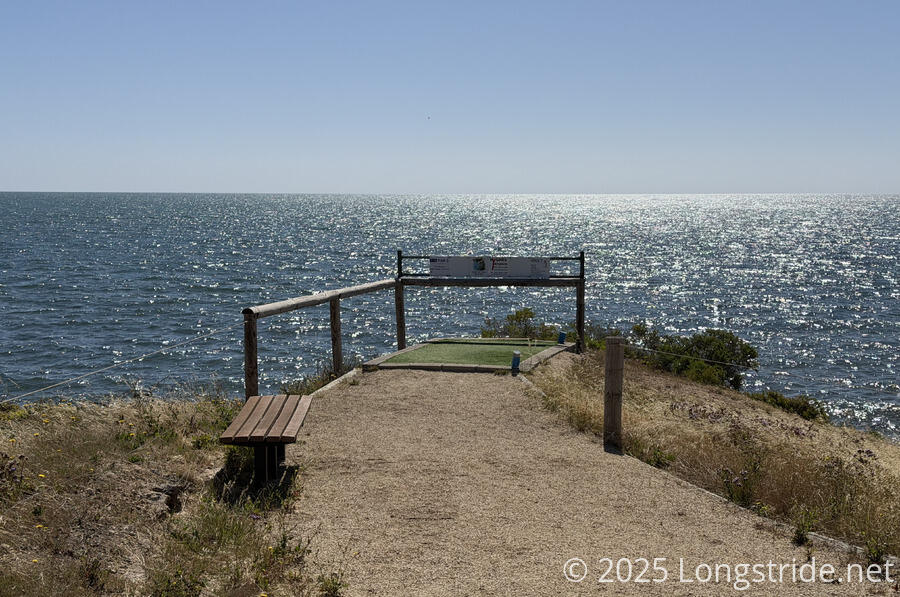
I’ll say, with the caveat that as a foreigner to Australia, I am almost certainly not the kind of person the memorial is targeted for, but I found the war memorial to be disappointing. What it did well was to represent all the various military units and divisions that contributed to Australia’s role in the Vietnam War, by naming them. But while there was some, there was not much in the way of story. So if you didn’t have the context of being educated in Australia, there was very little in the way of explanation of why Australia was in the war, and how it fared, what the overall resolution was, or even what the various units even did in the war.
But that said, the war memorial was on very nice scenery, had a lot of memorial benches, and was impressively long: it took us about 45 minutes to walk its entire length. If one had family or friends (from Australia) who participated, their unit was definitely somewhere on the walk in rememberance.
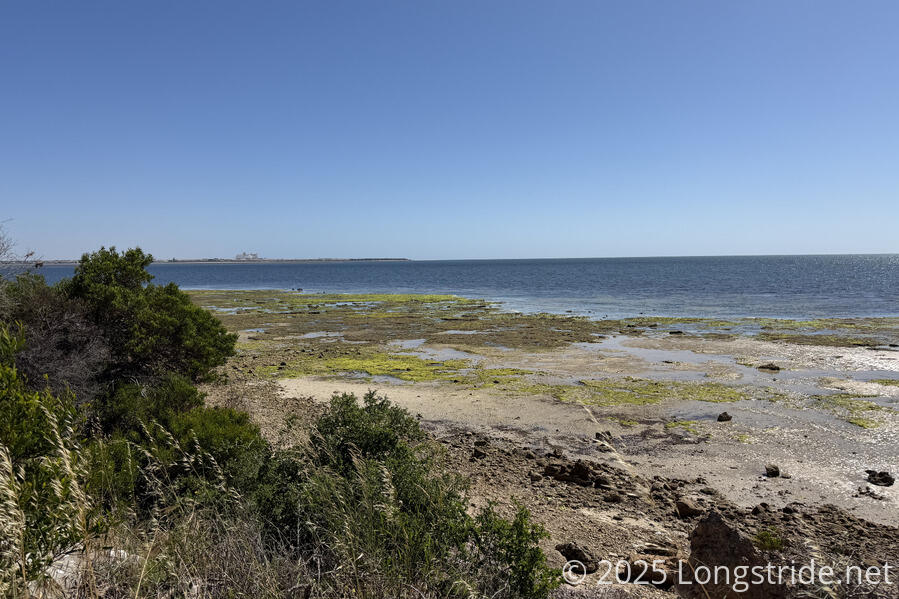
From the memorial walk, there were often clear views across MacDonnell Sound towards Port Giles, a bulk grain terminal. While the jetty wasn’t visible yet, the grain silos were prominent on the horizon.
We also weren’t the only people walking on the memorial walk, we passed at least a few other people walking our way, some of them with their faces completely covered to keep away the swarms of flies that were somehow even worse here than they’d been anywhere else so far. CareFree finally capitulated and put on her bug net to keep them off her face.
Exiting the memorial walk, we circled around a pond created by a causeway built in the late 1800s to shorten by several miles during high tide the distance between Edithburgh and Coobowie, the next town over. Which we were just about to enter, along its main road.
There was a caravan park in the town, had we been inclined to have a very short day, but there was otherwise not much of interest for us. All of the power poles, though, had small murals painted on them, which was a nice touch.
After leaving town, we continued to follow the road for a little while, until the trail branched off onto an adjacent dirt path separated from the road by some trees. Which was great, because there were a lot of road trains hauling grain.
We stopped for a break at another trail shelter. While we were there, a car drove in, dropped someone off who walked back the way the car came, and drove away. It all seemed a little weird, but maybe it was someone doing a short section of the trail? If so, they would have been the first person we’ve seen at all other than us actually hiking the trail.
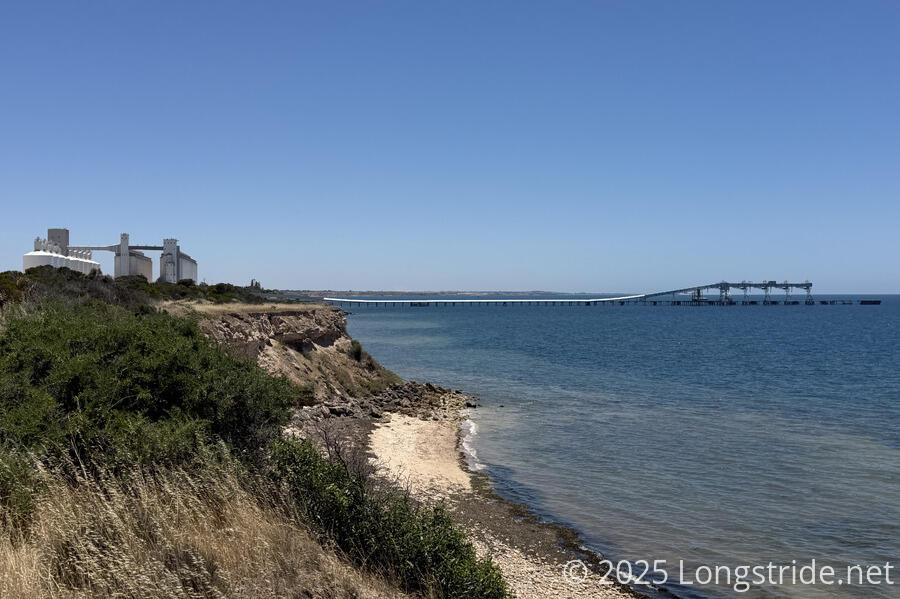
Leaving the shelter, the trail continued to hug the edge of the clifftop, until coming near the pier and grain storage at Port Giles. Built in 1967, the port and pier helped to expand bulk transport of grains across the Gulf Saint Vincent to Adelaide. Along with terminals in Ardrossan (to the north) and Wallaroo (north of Moonta Bay), these transitioned grains shipment from fleets of ketches to bulk container ships.
We also saw a couple of large ships out in the gulf, which especially once one got closer and we passed Port Giles, seemed like they were coming to receive a load of grain.
The Port Giles facility was quite busy, with a large number of trucks waiting in a parking area adjacent to the road to offload grain, and several more in the facility itself being processed.
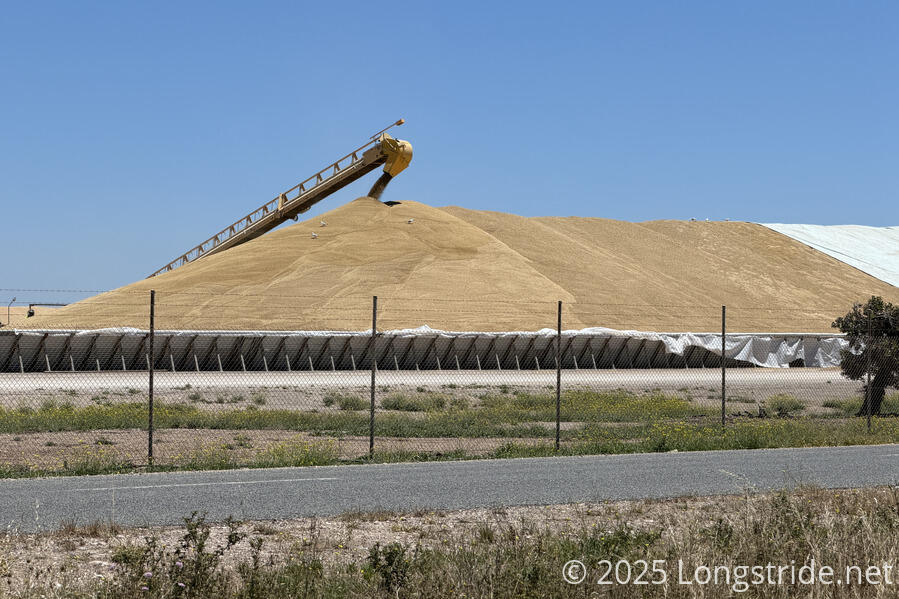
After walking through the truck parking area, and the overflow parking area, we resumed following trail overlooking the gulf.
The flies finally got so bad that I finally had to admit defeat. For only the second time ever, I put on my bug net while hiking. (The first time was seven and a half years ago, on the Pacific Crest Trail.) It was not as stifling as I remembered it being, though, this time I had a hat on that helped keep the net further from my face.
This stretch of trail was fantastic, and well-maintained. Often with a rock border lining the path, it seemed like it had been mowed recently, and had no overgrowth. Probably someone in the local community really cares about this section.
That ended at a picnic area near a historic lime kiln at Wool Bay. Apparently one of the best surviving examples of lime kilns on the peninsula, it was never economically successful, possibly due to its location at the top of a windy cliff.
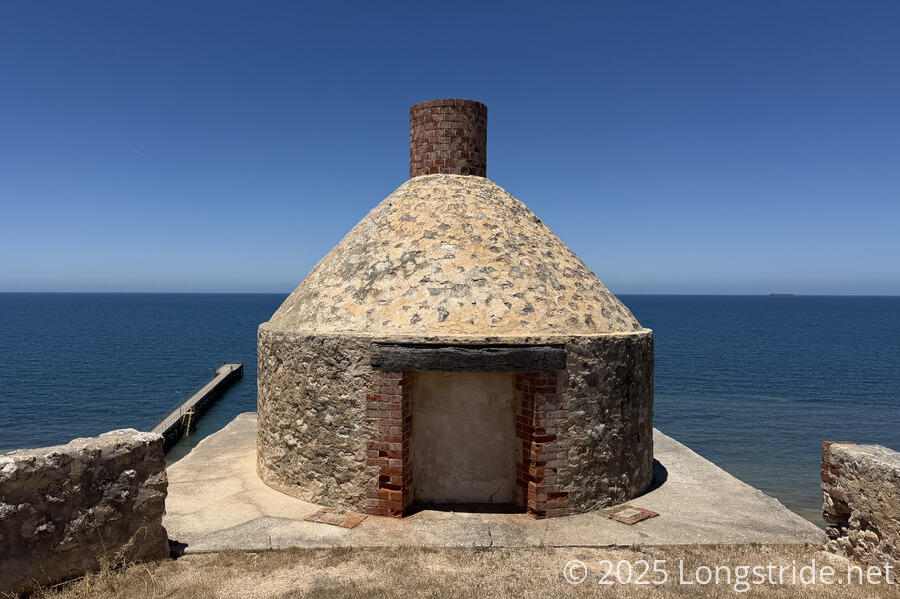
The break in the shade at the picnic table was nice, but the flies continued to be unrelenting, and quite possibly pushed us to depart more quick than we otherwise would have.
A short distance later, we turned inland, as the trail routed around the Klein Point Quarry, a limestone mining operation. Initially, a nice gravel cycle path paralleled the road, but it faded into a tiny path next to a farm fence, and we opted to walk along the road shoulder instead.
We passed a sign and a couple of traffic cones signaling the road was closed ahead for construction, but not actually blocking the road. With no further details, this could mean anything, so we figured there was probably enough space to walk around any road construction there was, and just kept going. A couple of cars drove past us and turned around, apparently not wanting to tempt fate.
At some point, I had to take off my bug net. It eventually got too hot and stifling, and I was surprised it took as long as it did before that became necessary.
Maybe half an hour later, a work truck drove towards us from ahead. We were told that the road was closed for safety reasons because the quarry was going to be blasting “promptly at 3:30”, and that we needed to clear the checkpoint another half-kilometer down the road before then. (This seems perhaps like the kind of important detail that ought to be included on signage, rather than just the vague “construction”. I guess they figured it’s no effort for a car to turn around and go a different route, and maybe even for cyclists as well, but it’s not quite so easy or quick when you’re walking.)
We hurried on to the checkpoint, which actually was blocking the road. Before we got there (though likely in sight of the guy manning it), we heard a series of rapid pops in the distance — they did their detonation three minutes early. A cloud of smoke floated over the road behind us, which would probably not have been especially noteworthy otherwise.
After they presumably cleared both of the roadblocks, the work crew drove up past us again, asking us, perhaps a little too excitedly, if we saw the explosion. We hadn’t — because it was early so we weren’t looking for it — but we said yes anyway. They then asked if we needed water, but we declined; we still had plenty.
After another 15 minutes, at a road intersection, we stopped at a partially shaded bench — there’s frequently been benches along the trail at road intersections.
The new road took us back towards the coast, taking us between two farms. The farm on our right had several run-down structures, including the ruins of a stone building, and a broken windmill with a large birds nest in its center.
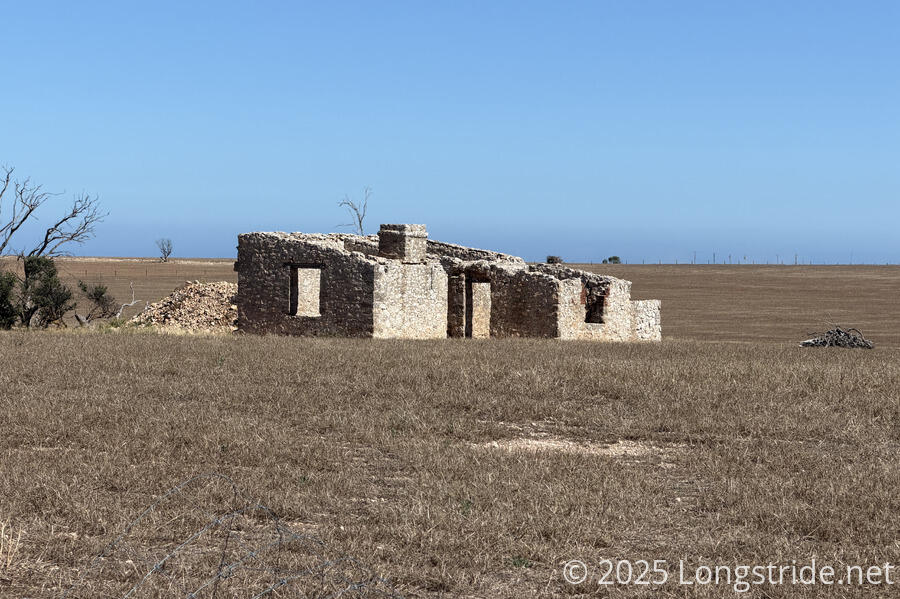
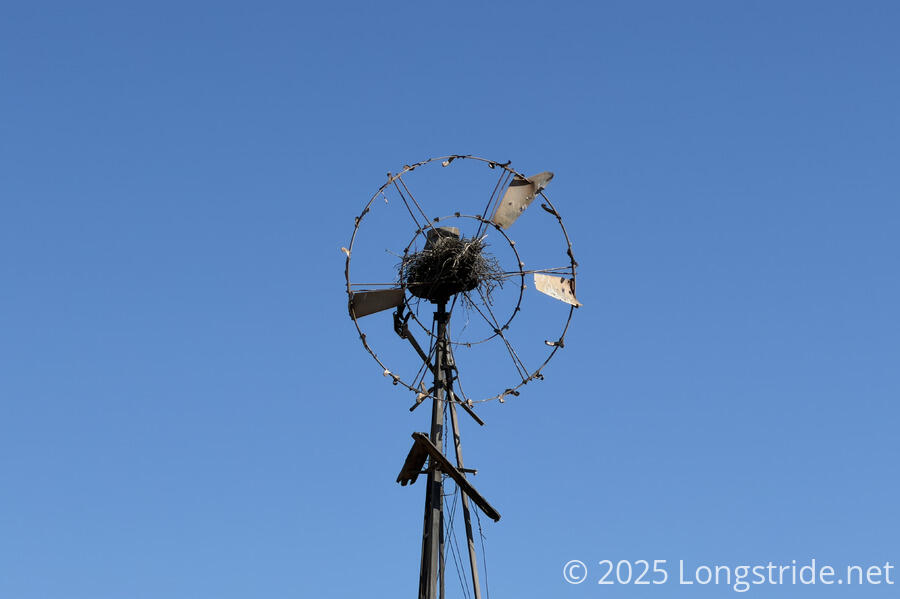
Once we were back on the coast, we joined a trail along the clifftop. Meandering up and down the cliff, between the ocean and homes, the trail brought us in to Stansbury.
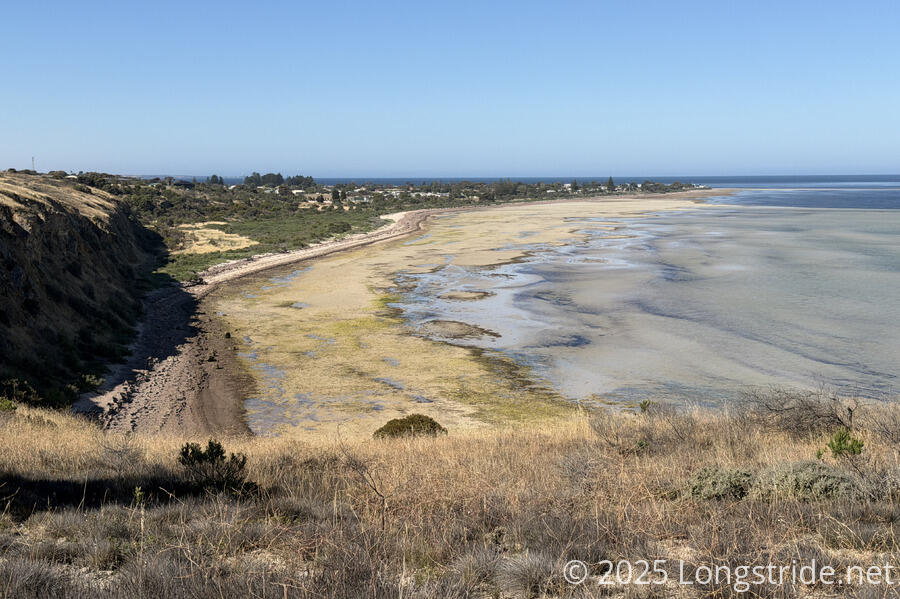
Today was one of the few days on the trail where we had no beach to walk on. It would have been nice to have some more variety; all the roadwalk was hard on our feet, but at least we were able to move pretty quickly today.
Reaching the Stansbury Caravan Park, we got our tent set up, and cooked dinner in their nice camp kitchen.
After dinner, we planned out the rest of the trail. The day after tomorrow, the weather is forecast to be excessively hot (93 °F / 34 °C), so we’re going to most likely zero again at the holiday park in Port Vincent to wait out the heat. (Ideally, we’d have a short day rather than a zero, and about 10 km further than Port Vincent is Port Julia, which has a bush campground, but with no structures, and no businesses, there’d be nothing to do and nowhere to go to escape the heat.)
After dark, a group of seniors came in to the kitchen to have a birthday party, and we chatted with them while everyone was gathering. One of them expressed surprise that we (as foreigners) were hiking the Walk the Yorke.
Eventually, we decided we needed some quiet, and retreated to our tent.
It’ll be warmer tomorrow than today, so ideally we’d leave “early”. But it’s only 18 km to Port Vincent, which will make tomorrow our shortest day on the trail. Hopefully, it’ll be a little less eventful than today.