Warmer weather blew in, and then blew out, as we continued south along the western Yorke Peninsula and made our way to Port Rickaby.
After two long days, and with even warmer weather forecast for today, we opted to cut the distance down a bit, and only aimed for 22 km to the caravan park in Port Rickaby. We started later than we’d have liked given the hot weather because we wanted to talk with the people at the Port Victoria Kiosk, to see if they had any idea of how CareFree might get off-trail and to Adelaide. It turns out there used to be a regular bus system that linked all the communities in the peninsula, but it had shut down long ago because there were no longer enough people using it. (Port Victoria used to also have a general store, which closed in June, and even the Kiosk was up for sale.)
Leaving Port Victoria, Walk the Yorke started along the Port Victoria Volcano Trail, a legacy of a large volcanic eruption two billion years ago that left the area littered with volcanic rock, some of which we had to hike over today. Over the next kilometer, the trail had about half a dozen markers with information on the area’s volcanic rocks.
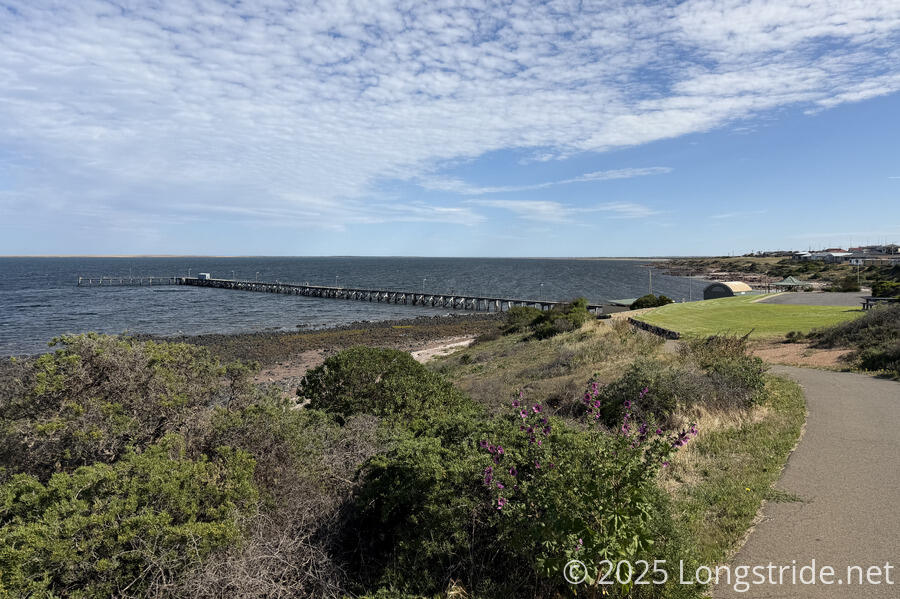
It was already noticeably warmer than it was yesterday — the owners of the Kiosk asked if we were sure we wanted to hike in this heat — though now that we were walking along the ocean, the cool breeze over the ocean helped keep it a little cooler.
We saw more pelicans and other seabirds, and another bobtail lizard when the trail briefly jogged inward between Rifle Butt Beach and Second Beach. (Who comes up with these names?)
Second Beach gave us more meter-high mounds of dried seaweed we had to trudge through. Truly, I’ve never seen as much seaweed before as I have the last three days on this trail.
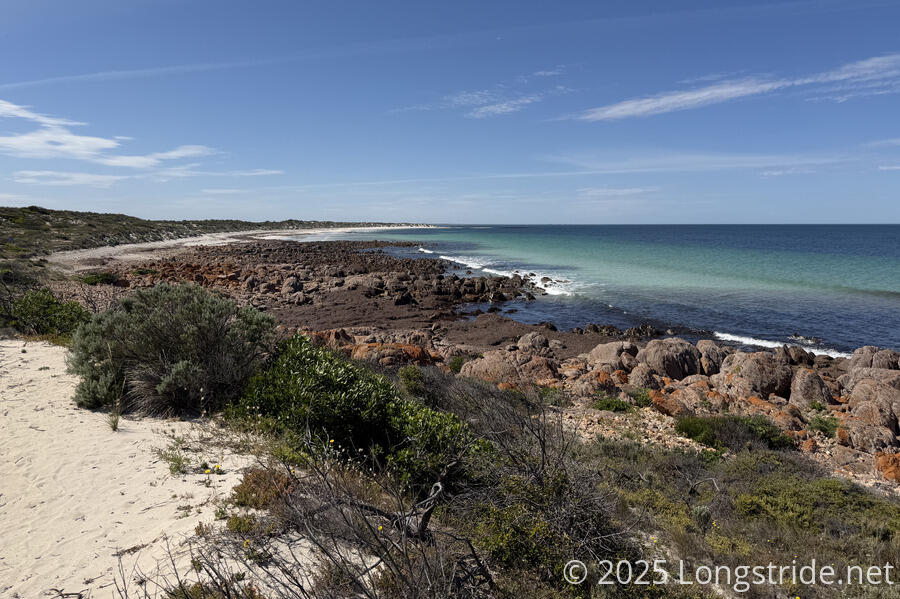
By early afternoon, the sun got stuck behind some clouds. This took the edge off the heat a little bit, which helped because the wind had also died down. It was also noticeably more humid than it had been yesterday, though that was probably a result of walking immediately next to a very large body of water.
About halfway into the day, we stopped at the Wauraltee Beach Shelter, about a seven minute walk off the beach along a dirt road. The shelter provided shade and water. On its picnic table sat a half-filled bottle of Coca-Cola, untouched for long enough to have collected dirt under its base. Not in dire need of extremely flat and warm soda, we left it as it was.
We rested for two hours at the shelter, skipping a good portion of the early afternoon sun and heat. While we were there, two trucks we passed on the beach drove by, one stopping to ask if we were doing okay in the heat.
Away from the breeze from the ocean, flies continued to plague us, though it was more annoying than miserable.
A sign next to the shelter explained that the shelter was situated on “Black Bob’s Road”, a well-used track by Aboriginal people, connecting both sides of the Yorke Peninsula on a route that included waterholes, hunting grounds and ceremonial areas.
Shortly before three, we returned to the beach and continued south, soon passing an area with two-meter tall piles of seaweed. Fortunately, we didn’t have to walk through that seaweed, just around it.
Clouds continued to blow in, keeping the sun hidden and cooling the air; despite being forecast to be hotter than yesterday, the afternoon felt cooler, though a bit more humid.
The flies that bothered us this morning and at the shelter were largely blown away by the wind coming off the ocean.
We continue to see very few people on the beach. Aside from the two cars, we only saw one other person on the beach, about two hours before we reached Port Rickaby.
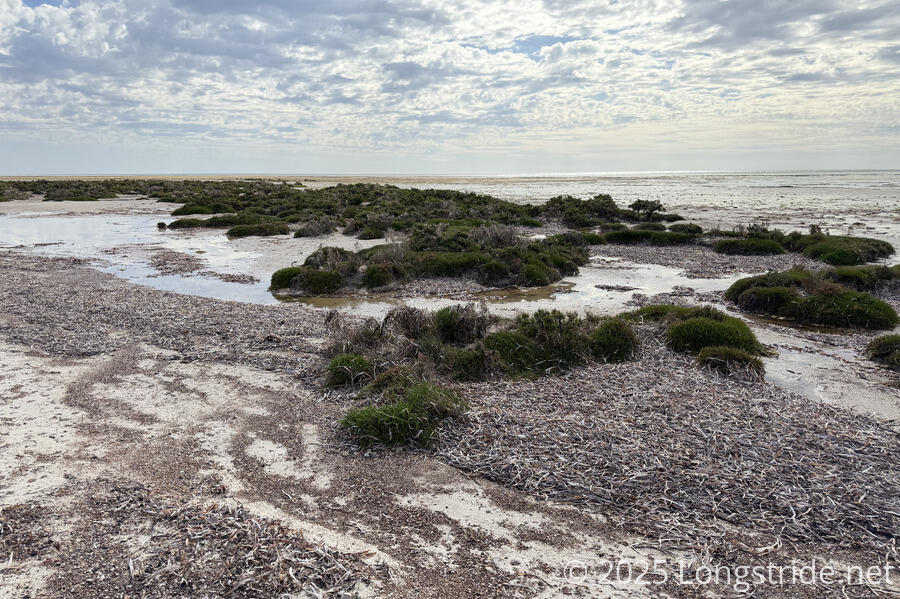
The beach continued to be largely monotonous, with dunes to the left, shallow water to our right, and a reasonably wide, occasionally seaweed-filled beach. Some small grass filled islands in the intertidal zone added some variety to the ocean landscape.
We reached Port Rickaby and its caravan park shortly before six, getting quickly checked in. The kiosk was still open, so we were able to get hot dogs and fries for dinner. (Though, we got more fries than we could eat, and I should have gotten fewer fries and a second hot dog.)
We chatted briefly with the owner of the caravan park. We asked about how the towns in the area seemed to be so empty; he said there’s only about 30 people that live in Port Rickaby year-round, and well over a thousand who come to the area in the summer. I suggested that this sounds like it would make it really hard to have a functioning community; he agreed.
Showers were, of course, fantastic, and helped to relax after another hot day on the beach. Tenting at a caravan park isn’t free, but the amenities are well worth it.
Tomorrow, we’ll have another “short” day, 21 km to the campsite at Port Minlacowie.