Our penultimate day on the trail gave us some great views and our first wombat (after a fashion).
It rained briefly overnight, accompanied by some birds chirping — probably the lorikeets in the tree we saw last night. It was windy overnight, as it had been most nights, and we expected it to continue that way throughout the day.
Leaving Ardrossan, we returned to the coast and continued north, initially on a clifftop path, which gave us a great view of Ardrossan and its piers.

Turing inland, we passed through the town of Tiddy Widdy Beach (a corruption of the Aboriginal place name Titty Witty Titty), and then joined a wide dirt cycle path sandwiched between a larger dirt road, and a farm.
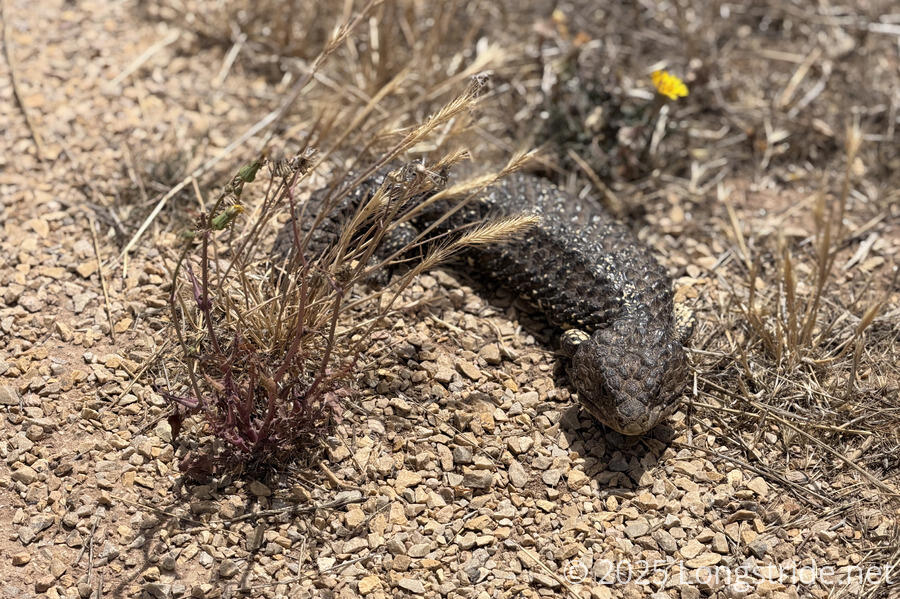
In short order, we saw three sleepy lizards, and also a sign about the death adder snake, which had us seriously questioning all of the stomping through seaweed we had done along the beach.
We diverted from the trail briefly to shortcut a trip through sand dunes. Comments in a trail guide suggested that it was soft, shifting sands that is very slow to walk through. This, naturally, took us along more farmland, but at least the cyclepath was far enough away from the dirt road that the dust kicked up from people driving way too fast down it didn’t really bother us.

Later, we saw a grain harvester in operation in a field. Our first couple of days on the trail, we saw dust clouds from them off in the distance, and while this one was still far away from us, it was nice to actually see the machinery in operation, rather than just its effects.
On the outskirts of Price, the next town along the trail, we passed by a series of salt evaporation pods, most of which were pinkish-colored. Apparently, salt flats change color based on their salinity, with pink indicating a mid-to-high salinity pond.
In Price, we stopped at the caravan park, hoping their camp store had soda and ice cream. The store was closed, but we’d just timed it just right that the manager happened to be there, and opened up the store for us. Like the manager at Pine Point, he was very enthusiastic and chatty, and offered to let us charge our devices and use the restrooms if we needed.
Leaving Price, we passed yet another golf course, and entered the Wills Creek Conservation Park.
This took us through another area with enough wombats to warrant a sign. These wombats were even more prolific tunnel builders than what we saw north of Pine Point. They had dozens of entrances on the sides of the trail, as well as the hillside nearby. The hill had visible ripples from the funnels built just below the surface.
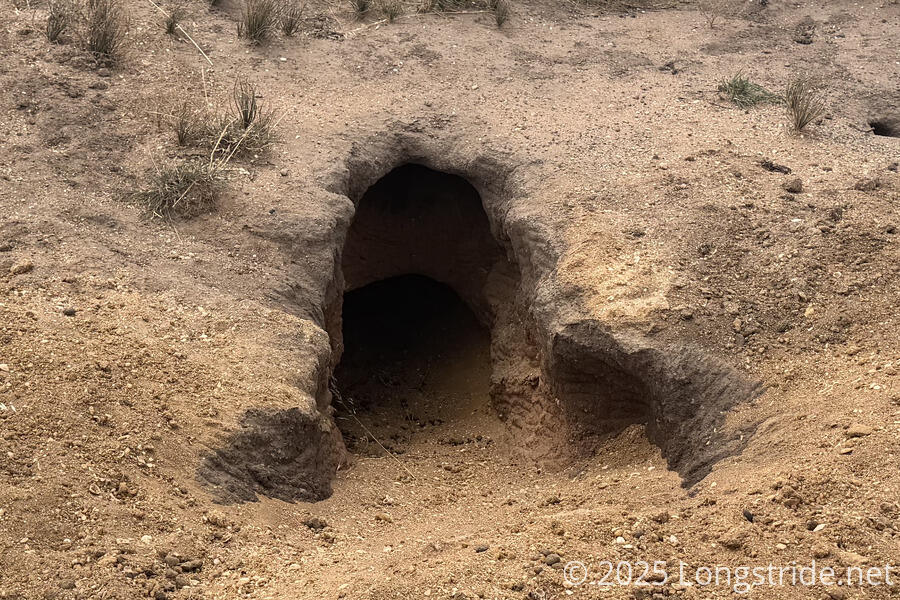
We still haven’t seen any (live) wombats, but we did see one unfortunate casualty, a dead, desiccated wombat just past the fence along the trail.

Although the trail once continued at the base of the cliff, a sign marked that it was closed for revegetation, and we were climbed a long, steep staircase to the top.
Further on, we saw Wills Creek, which might be the first flowing body of water we’ve seen on this trail.
When I was originally researching Walk the Yorke, I’d remembered reading something about an estuary crossing, but I couldn’t find it either on the map or in the trail notes. Perhaps this creek was that crossing.
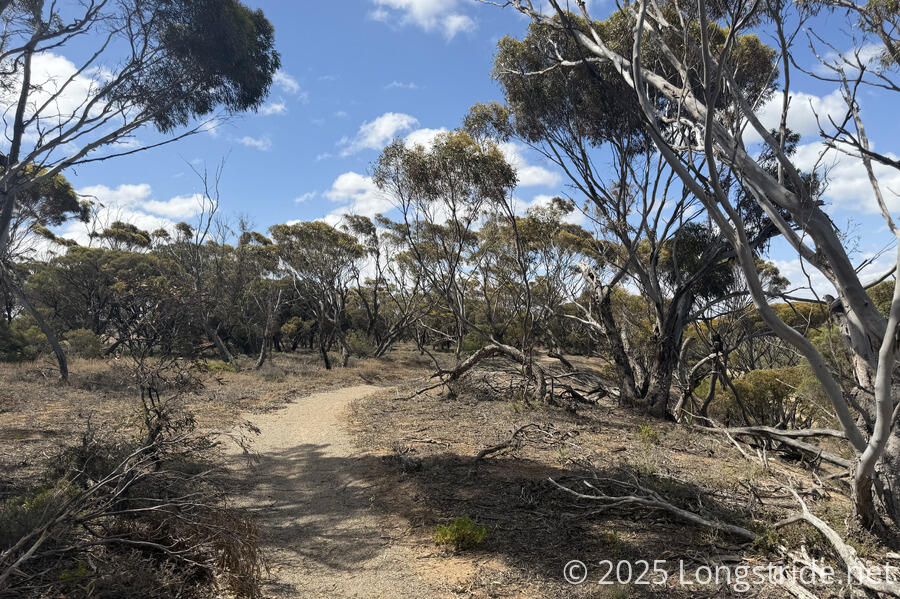
On the clifftop, we went through a small forest. It would seem that, as we travel up the peninsula, the land can support more trees.
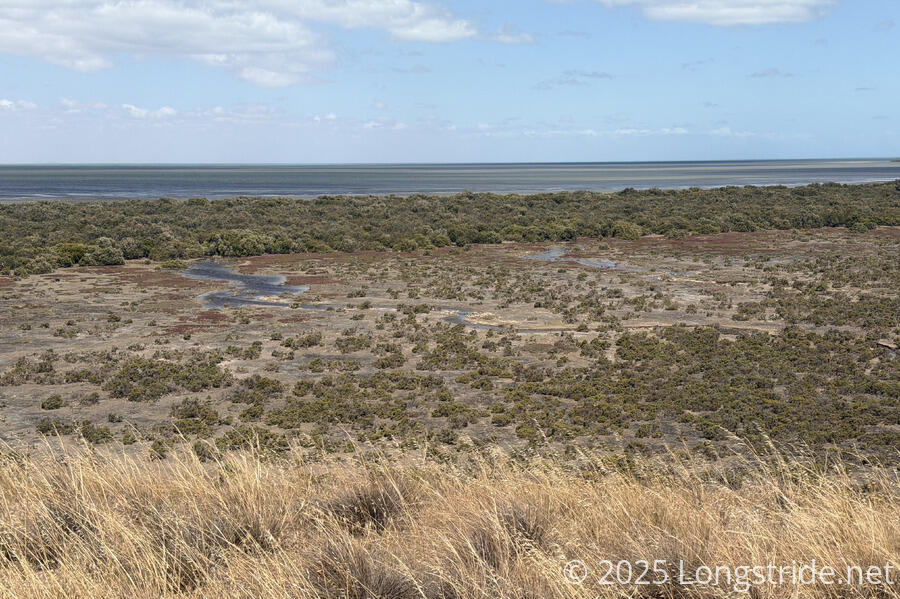
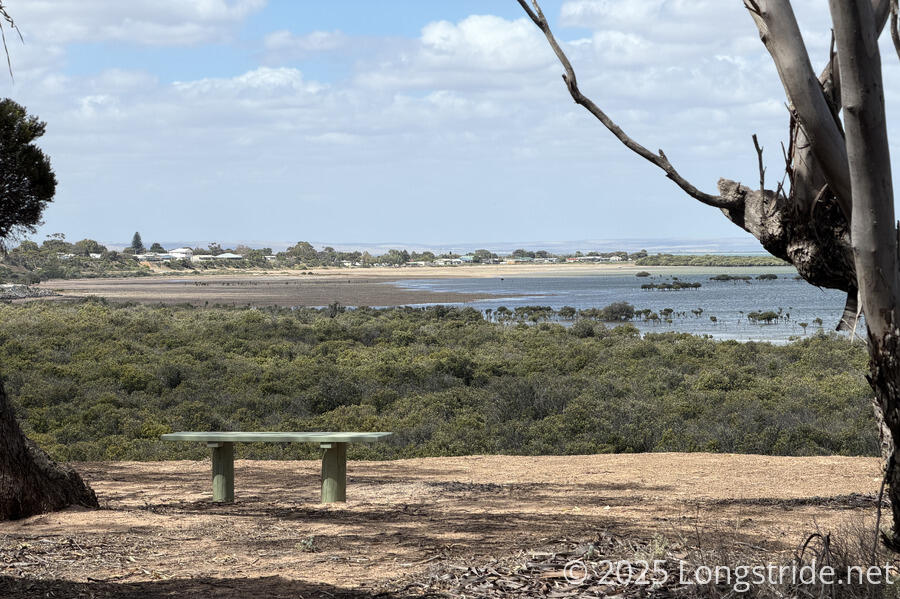
We stopped for a break at a bench with an incredible view of the mangrove swamp south of Port Clinton. It was so nice, we spent a little longer here than we’d wanted; the caravan park’s office closed at 5, and we wanted to get there before then on the off chance they’d have (you guessed it) soda and ice cream.
As we hurried the final short distance to town, we smelled smoke, and passed the burnt ruins of a house, with a small fire still in progress.
My first thought was that someone had started a bonfire, but with it being as windy as it was, they would have to be monumentally stupid to have done that. (It was hard to tell if this was the end of the house burning down, or it had previously burnt down, and someone or something restarted a fire long afterwards. And it’s not like we were going to get closer to it to investigate, what with the zero skills we have in that department.)
There didn’t seem to be anyone else around the property, so after some fumbling around trying to figure out what Australia’s emergency number is (000), we called and reported the fire, and then continued into town.
When I booked a campsite here, I told them we’d probably be here around 6:30 or 7, given the long day we had. But we got there shortly before 5, much earlier than we were expecting! They’d already closed the office since they weren’t expecting us yet, but per our conversation when I called earlier today, I called them, and they gave us a location to camp at and we’d settle up tomorrow morning. A sign on the door also had hours for the general store, which had long been closed.
As we started to set the tent up, we could hear siren sounds in the distance, likely the fire department responding to our call.
It was very windy. While it’s been windy every evening on the trail, this evening was, by far, the worst. After we’d gotten the tent set up, a strong gust of wind blew it nearly flat, inducing us to hastily move it to somewhere only barely less windy. (The manager had warned me this morning it was going to be windy, but I said I wasn’t worried about it. In retrospect, maybe I should have been.)
Even moreso than the caravan park in Ardrossan, the Port Clinton Caravan Park seemed to be nearly entirely permanent caravans. There were only a handful of grassy areas to even pitch a tent. The park had a nice shower block, but no kitchen whatsoever, though a nice picnic area and BBQ grill across the street next to the waterfront somewhat made up for that.
Or, at least, it would have, if it hadn’t been so windy. We tried to cook dinner, but it was so windy our camp stoves really didn’t work so well. I wound up cooking from the tent; the vestibule area was largely shielded from the wind.
Tomorrow, one final long day will take us to Port Wakefield, the end of Walk the Yorke.